
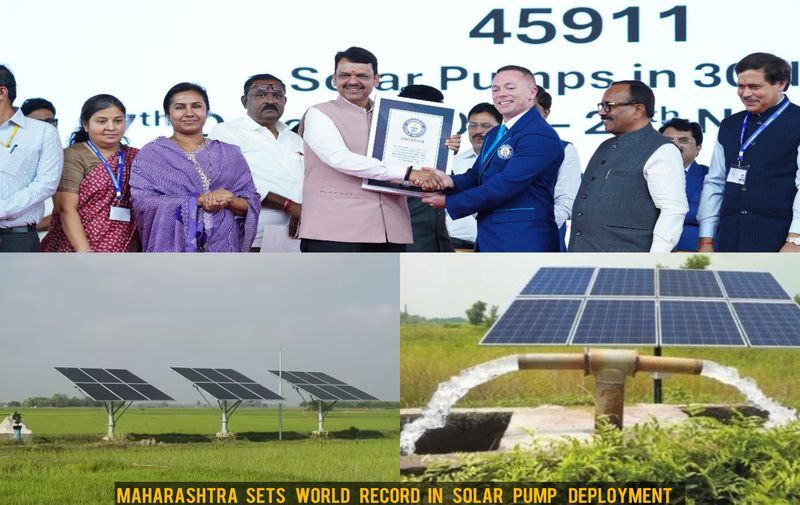
Solar Revolution in Maharashtra: Guinness World Record Achieved
Maharashtra has entered the global spotlight with a groundbreaking renewable energy achievement, installing 45,911 off-grid solar agricultural pumps within a span of just 30 days. This remarkable feat, now officially recognized by Guinness World Records, represents not just administrative efficiency but a decisive shift toward sustainable irrigation and rural energy independence. At a time when India is accelerating its clean energy transition, Maharashtra’s rapid deployment shows how targeted policies, political will, and technological adoption can create nationwide impact.The scale and speed behind the world recordThe record-setting installation was executed under two major schemes, PM-KUSUM Component B and the Magel Tyala Saur Krushi Pump Yojana. These initiatives together provided the financial support, subsidy structure, and administrative backing needed to make large-scale solar pump deployment possible. The pace of installations places Maharashtra second only to China in global rankings for the fastest solar pump deployment by a single administrative region. For a state with a large agrarian population, this marks an agricultural transformation led by clean energy.The power of leadership and political commitmentChief Minister Devendra Fadnavis emphasized that the PM-KUSUM initiative played a crucial role in making solar pumps accessible across the state. Maharashtra has already set up more than 7.47 lakh solar pumps and has its eyes on reaching the 10.45 lakh mark in the coming phase. Leaders across departments highlighted that solar irrigation is not just an energy transition; it is an agricultural transformation that reduces pressure on the conventional grid and ensures farmers receive a stable, reliable water supply without interruptions or electricity shortages. For thousands of rural households, this translates into better planning, improved crop cycles, and reduced stress during crucial farming seasons.Strengthening agriculture through clean energySolar pumps have become a lifeline for farmers who have long depended on erratic electricity connections or costly diesel pumps. Switching to solar means irrigation becomes predictable, sustainable and more affordable over time. Families no longer have to wait for late-night agricultural feeder electricity and can plan irrigation according to crop needs instead of grid schedules. What this truly achieves is a shift in confidence for rural communities, empowering farmers with control over their resources. This human dimension makes Maharashtra’s achievement more than just a technical milestone; it is a social and economic uplift.Efficient governance and strict monitoringMSEDCL Chairman Lokesh Chandra credited the success to robust administrative planning, transparent vendor empanelment and continuous monitoring of service-level compliance. The state implemented strict rules ensuring that any complaint by a farmer must be resolved within three days, limiting delays and building trust in the system. Vendor accountability played a major role, with companies such as GK Energy contributing nearly 17 percent of total installations during the record month. Solar pump capacity continues to be tailored to land size, ranging from 3 HP to 7 HP, ensuring that farmers receive systems suited to their agricultural needs.A long-term vision for sustainable irrigationMaharashtra has now adopted a long-term policy to prioritize off-grid solar pumps for all future agricultural connections. This shift aims to reduce dependence on traditional electricity networks that are costly to maintain and often struggle with high demand and rural load. Off-grid solar pumps ensure clean, uninterrupted irrigation even in remote areas where the grid is weak or nonexistent. This policy direction reflects a future-oriented mindset: long-term environmental sustainability, reduced carbon footprint and resilient agricultural systems capable of withstanding climate variability.A model for India’s renewable futureMaharashtra’s achievement demonstrates what is possible when governance, technology, finance, and community participation intersect. The record installations mark a turning point in India’s renewable energy landscape. While the numbers are historic, the human impact is even greater: more stable crops, reduced expenses, better livelihoods and a sense of empowerment in rural communities. By embracing solar irrigation at such a scale, Maharashtra has created a model that other states can adapt to strengthen both their agricultural and environmental futures.