
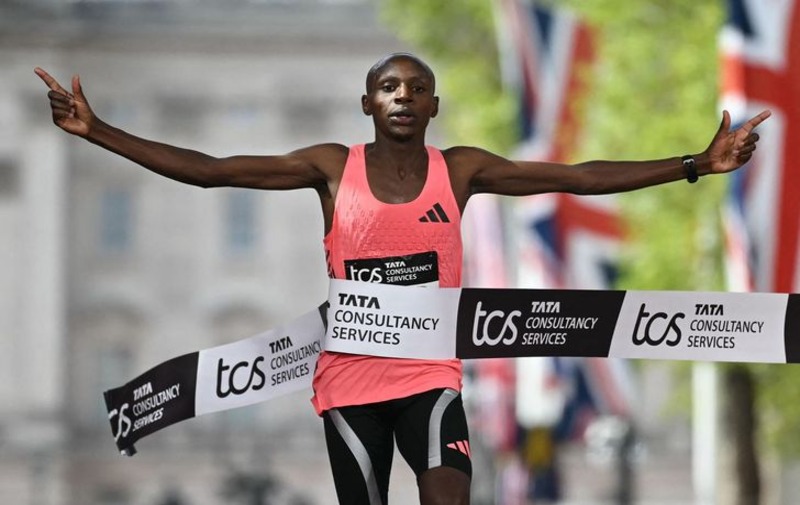
History Made in London as Sabastian Sawe Smashes the Sub-Two Hour Marathon Barrier in a Jaw-Dropping Run
On a charged Sunday morning in London, something extraordinary unfolded—something that athletes, scientists, and dreamers had chased for decades. The London Marathon, already one of the world’s most iconic races, became the stage for a moment that will forever be etched in sporting history. Sabastian Sawe, a 31-year-old from Kenya, crossed the finish line with a time that seemed almost unreal: 1 hour, 59 minutes, and 30 seconds. With that single run, Sawe didn’t just win a race; he shattered one of athletics’ most elusive barriers, becoming the first man to run a marathon under two hours in official race conditions.Chasing a Barrier Once Thought UntouchableFor years, the idea of completing a marathon of 42.195 kilometers in under two hours had felt like a distant dream. While Eliud Kipchoge famously broke the barrier in 2019, it came under controlled conditions that did not count as an official record. The sporting world celebrated it, but the official mark still stood. That mark belonged to the late Kelvin Kiptum, whose remarkable 2:00:35 at the Chicago Marathon in 2023 had already pushed the limits of human endurance. But on this day in London, Sawe went further when he broke that record.A Race Run at Relentless SpeedFrom the very start, Sawe set a pace that left spectators and competitors in awe. He covered the first 5 kilometers in just 14 minutes, a speed that most runners struggle to maintain even over much shorter distances. By the 10-kilometer mark, he was at 28 minutes, maintaining an almost mechanical consistency that defied fatigue. What made the run even more astonishing was his ability to sustain this pace throughout the race. He recorded two sub-60-minute half marathons within the full marathon distance, an achievement that speaks volumes about his endurance and discipline. As he powered through the final stretch along the River Thames, cheered on by nearly a million spectators, Sawe showed no signs of slowing down. When he crossed the finish line near Buckingham Palace, history had already been written.The Stat That Left the World StunnedWhile the record time itself was mind-blowing, one comparison captured the imagination of fans across social media. A journalist pointed out that even if someone rode a high-speed Lime scooter capable of reaching 12.5 miles per hour—around the marathon course without stopping, they would still finish more than a mile behind Sawe. It’s a statistic that sounds almost impossible, yet it perfectly illustrates the sheer speed at which Sawe ran. He wasn’t just fast; he was operating at a level that redefines what we consider humanly possible.Preparation, Pain, and PersistenceBehind this historic performance lies a story of discipline and resilience. Sawe trained relentlessly, running nearly 150 miles a week to prepare his body for the demands of elite competition. His diet remained simple, reportedly fueled by basics like bread and honey, but his commitment was anything but ordinary. What makes his achievement even more inspiring is the adversity he faced leading up to the race. Injured during the autumn season, Sawe only resumed proper training in January. By February, he began to believe he could return to peak form. Within just a few months, he transformed doubt into dominance. His journey is a reminder that greatness is not always about perfect preparation; it is often about the ability to rise, adapt, and push forward despite setbacks.Technology Meets TalentSawe’s run also highlighted the evolving role of technology in sports. He, along with several top finishers, wore the Adidas Adios Pro Evo 3 a pair of ultra-light “super shoes” weighing just 97 grams. Designed with advanced foam and a carbon plate, these shoes are engineered to maximize energy return and efficiency. While such innovations contribute to performance, they cannot replace the human element. Shoes can enhance, but they cannot create the kind of endurance, mental strength, and determination that Sawe displayed on that day. The 2026 London Marathon will be remembered not just for Sawe’s victory but for the extraordinary level of competition it showcased. Yomif Kejelcha pushed hard for much of the race, finishing second in his marathon debut. Jacob Kiplimo secured third place with another exceptional performance. For the first time in history, multiple athletes came close to or broke the two-hour barrier in a single race. It marked a turning point, suggesting that what was once extraordinary may soon become the new standard.A Moment That Changes EverythingSabastian Sawe’s record-breaking run is more than a sporting achievement; it is a milestone that redefines possibility. It challenges athletes to dream bigger, trains coaches to think differently, and inspires millions around the world to believe in the power of persistence. For decades, the sub-two-hour marathon was seen as an unreachable frontier. Today, it is a reality. And somewhere, perhaps in a small village or a crowded city, a young runner is watching this moment and thinking, “Maybe I can do it too.”