
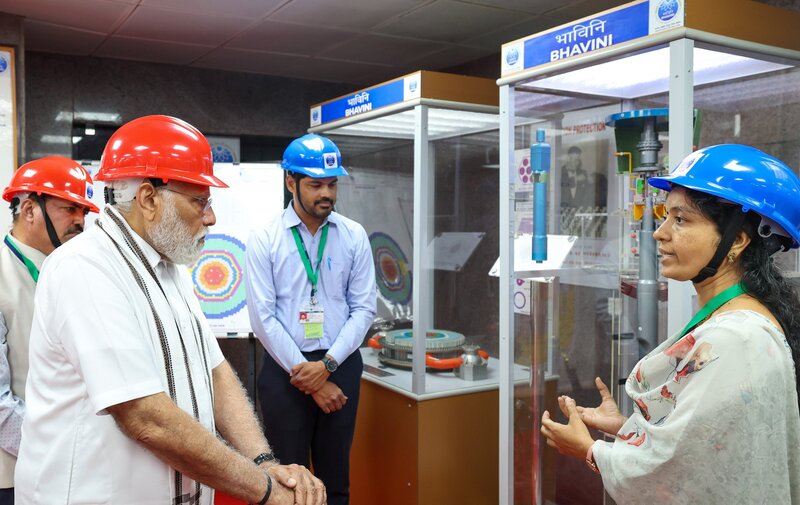
BIG WIN for India! Indigenous Nuclear Reactor Achieves Critical Milestone
India’s journey toward energy independence has reached a historic milestone. At Kalpakkam, the indigenously developed Prototype Fast Breeder Reactor (PFBR) has successfully attained criticality a moment that signals not just scientific progress, but a bold step toward a cleaner, self-reliant future. Calling it a “defining step” in India’s civil nuclear journey, Narendra Modi praised the achievement, highlighting how it advances the second stage of India’s ambitious three-stage nuclear programme. But beyond the technical success lies a deeper story—one of vision, perseverance, and national pride.What Does ‘Criticality’ Really Mean?In simple terms, criticality is the point where a nuclear reactor becomes self-sustaining. It means the reactor has successfully initiated a stable chain reaction where each nuclear fission produces enough energy and neutrons to continue the process without external support. While this does not yet mean full electricity generation, it is a crucial milestone. It confirms that the reactor’s core is functioning exactly as designed and safely. Think of it as the moment a car engine starts successfully before hitting the highway—it signals readiness for the journey ahead.Understanding the Prototype Fast Breeder ReactorThe PFBR is not just another nuclear reactor it represents cutting-edge technology. Developed by Bharatiya Nabhikiya Vidyut Nigam Limited (BHAVINI), this 500 megawatt electric reactor has been designed and built entirely in India, with contributions from over 200 domestic industries. What makes it unique is its ability to produce more fuel than it consumes.Unlike conventional reactors, the PFBR uses Uranium-Plutonium Mixed Oxide (MOX) fuel. Surrounding this is a “blanket” of Uranium-238, which transforms into more usable fuel during the process. This means the reactor not only generates energy but also creates additional fuel for future use—a breakthrough in efficiency.The Backbone of India’s Three-Stage Nuclear ProgrammeIndia’s nuclear vision, originally conceptualized by Homi Jehangir Bhabha, follows a three-stage programme designed to maximize the country’s energy resources. Stage 1: Uses natural uranium in Pressurised Heavy Water Reactors Stage 2: Utilizes plutonium in fast breeder reactors like PFBR Stage 3: Focuses on thorium-based reactors The PFBR plays a crucial role in the second stage, acting as a bridge to the future. India has one of the world’s largest thorium reserves, and this reactor is a key step toward unlocking that potential. By producing more fissile material, it prepares the groundwork for thorium-based energy in the third stage. This milestone is not just about nuclear physics—it’s about India’s future. First, it strengthens energy security. By generating more fuel domestically, India can reduce its dependence on imported uranium. Second, it supports clean energy goals. Nuclear power produces minimal carbon emissions, making it vital for achieving India’s net-zero target by 2070. Third, it boosts technological leadership.Once fully operational, India will become only the second country after Russia to run a commercial fast breeder reactor. This places India among a select group of nations mastering advanced nuclear technology.A Story of Self-RelianceThe PFBR is also a shining example of India’s push for self-reliance under the Aatmanirbhar Bharat initiative. Built with the support of over 200 Indian industries, including many MSMEs, the project showcases the country’s engineering strength and innovation capabilities. From design to execution, this is a homegrown success story. It reflects what India can achieve when science, industry, and vision come together. Modern nuclear technology demands the highest safety standards—and the PFBR delivers. The reactor is equipped with advanced passive safety systems. These systems are designed to automatically shut down the reactor in case of any irregularity, without requiring human intervention. This ensures that even in extreme situations, safety remains uncompromised. The success of the PFBR at Kalpakkam is a reminder that big dreams take time, patience, and belief. And when they finally come to life, they don’t just power cities; they power a nation’s confidence.