
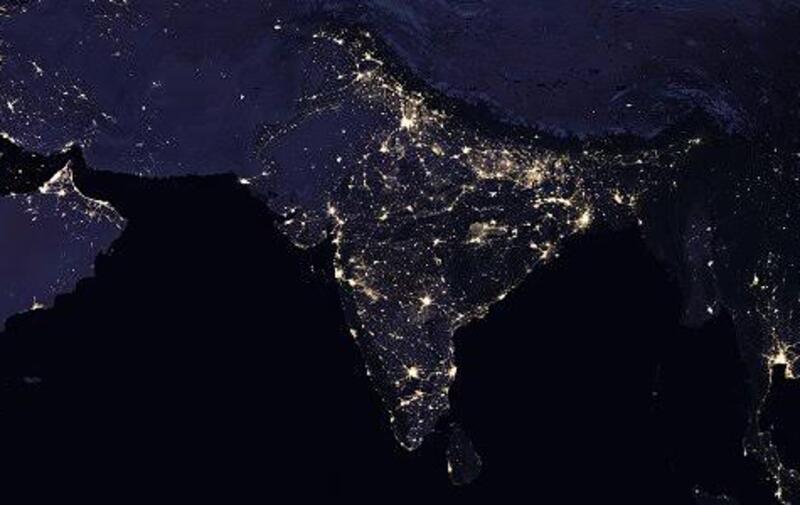
Why the NASA Night Map Shows Uttar Pradesh and Bihar Glowing and How India Got There
Under the silent vastness of space, Earth tells its story in light. Every glowing city, every lit highway, every village bulb switched on after sunset becomes part of a larger narrative, one of human progress. Recently, a striking global nighttime map released by NASA captured that story in extraordinary detail. Among the brightest regions on the planet, an unexpected area stood out the densely populated belt of Uttar Pradesh and Bihar. For many, the image was surprising. For others, it was deeply symbolic.A Map That Sees Beyond DarknessThe map, built using data collected between 2014 and 2022, is not just a visual spectacle; it is a scientific achievement. Researchers analysed nearly 1.6 million satellite images taken nightly using the Visible Infrared Imaging Radiometer Suite (VIIRS), a powerful instrument capable of detecting even the faintest light sources on Earth. Led by scientists Tian Li and Zhe Zhu from the University of Connecticut, the study used advanced algorithms to track changes in nighttime illumination over nearly a decade. The results revealed patterns of growth, development, and human activity across continents. Golden hues marked regions growing brighter, while darker shades indicated areas with less light or even decline. But what truly caught attention was the intense glow spreading across northern India.The Rise of a Bright BeltThe Uttar Pradesh-Bihar belt, long associated with dense populations and complex socio-economic challenges, emerged as one of the most illuminated regions in the world. From space, this stretch of land shines almost as brightly as some of the most developed urban clusters globally. This brightness is not accidental. It reflects a combination of factors—rapid urbanisation, improved electricity access, expanding infrastructure, and sheer population density. Over the past decade, millions of households in these states have gained access to electricity, transforming not just cities but also rural landscapes. Where darkness once defined evenings, today streets glow, homes are lit, and small businesses run longer hours. This shift is visible from space, but its real impact is felt on the ground.The Other Side of the LightWhile the map has sparked pride and fascination, it has also raised important questions. Increased brightness can sometimes indicate rising light pollution, which affects ecosystems, wildlife, and even human health. Artificial lighting can disrupt natural cycles, from migratory patterns of birds to sleep patterns in humans. Experts caution that while development is essential, it must be balanced with sustainability. Efficient lighting, reduced wastage, and environmentally conscious urban planning can help ensure that progress does not come at the cost of ecological harm. The glowing belt of northern India, therefore, represents both achievement and responsibility.Seeing Progress from SpaceWhat makes this map truly remarkable is its ability to connect the microscopic with the cosmic. A single bulb in a village, when multiplied by millions, becomes a visible force from space. It shows how collective human effort policies, infrastructure, and individual aspirations can reshape the planet’s appearance. The study also highlights how satellite technology is evolving. With the ability to detect light as small as a toll booth on a highway, scientists can now monitor development patterns with unprecedented precision. Governments and researchers can use this data to plan better cities, allocate resources effectively, and understand socio-economic trends.A Brighter TomorrowThe viral reaction to the map reflects more than just curiosity; it reflects a sense of identity and pride. For many Indians, seeing regions like Uttar Pradesh and Bihar shine so brightly challenges old narratives and highlights a new reality. It is a reminder that progress does not always come with headlines or dramatic announcements. Sometimes, it arrives quietly, one connection, one household, one streetlight at a time. As Earth continues to glow brighter in the eyes of satellites, the real question is not just how much light we produce but how wisely we use it.