
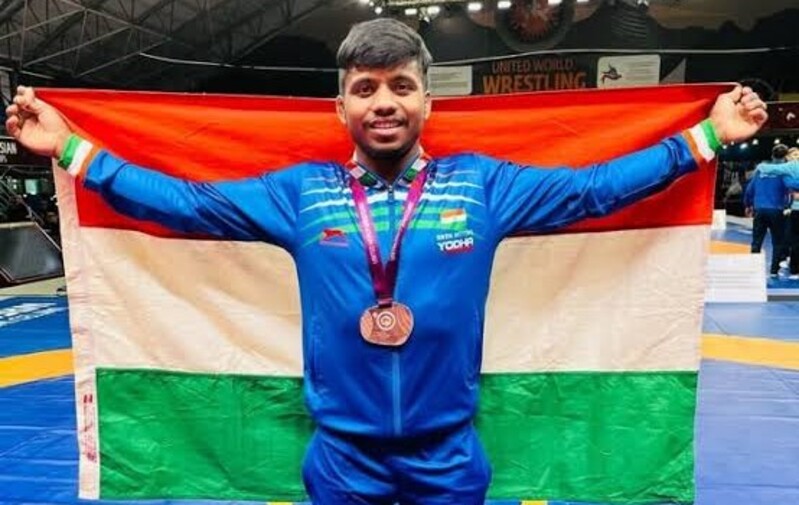
Lalit Sehrawat Clinches India’s First Greco-Roman Silver at the Asian Championships
In sports, victory is often celebrated, but sometimes, even in defeat, a story of pride, resilience, and promise emerges. For India, that story unfolded on the wrestling mats of Bishkek, Kyrgyzstan, where a young wrestler stepped forward and made the nation take notice. At just 23, Lalit Sehrawat didn’t just win a medal—he reignited belief in India’s Greco-Roman wrestling.A Silver That Feels Like GoldCompeting in the 55kg Greco-Roman category at the 2026 Senior Asian Wrestling Championships, Lalit Sehrawat scripted a remarkable journey to the final. Though he went down 0-9 against Uzbekistan’s world No. 7 Ikhtiyor Botirov in the gold medal bout, his silver medal carried far greater significance. It marked India’s first silver in Greco-Roman wrestling at the Asian Championships in three years. More importantly, it was Lalit’s first senior medal at this level, a breakthrough moment that signals the arrival of a promising new contender on the international stage. Lalit’s journey to the podium was built on skill, strategy, and sheer determination. In the semi-final, he delivered a commanding performance against China’s Huoying Shi, winning 11-3 in a bout that showcased both technical precision and attacking confidence. Ranked 12th in the world, Lalit entered the tournament as an underdog. But with every match, he proved that rankings don’t define hunger. Each move on the mat reflected hours of training, discipline, and the relentless pursuit of excellence.Greco-Roman Wrestling in IndiaIndia’s Greco-Roman wrestling is a style of wrestling practiced in the country where athletes can use only their upper body, arms, chest, and torso to attack or defend. Unlike freestyle wrestling, holding or using the legs is not allowed, making it a sport that demands immense strength, balance, and technical skill. In India, Greco-Roman wrestling has been growing steadily, supported by national training programs, international exposure, and young athletes stepping onto global platforms. Governed by the Wrestling Federation of India, the sport is part of major events like the Olympics and Asian Championships. Although India has traditionally been stronger in freestyle wrestling, recent performances by emerging wrestlers are bringing attention to Greco-Roman. It represents discipline, strategy, and physical endurance, and today, it is becoming an important part of India’s journey to becoming a global powerhouse in wrestling.A Tough Final, A Bigger LessonFacing Ikhtiyor Botirov in the final was always going to be a challenge. The Uzbek wrestler, ranked among the world’s best, brought experience and dominance to the mat. The 0-9 scoreline may seem one-sided, but it tells only part of the story. For Lalit, this match was not just about winning—it was about learning, adapting, and understanding what it takes to compete at the very highest level. Every champion, after all, is shaped as much by their losses as by their victories. Lalit’s silver is not an isolated achievement. It reflects a broader resurgence in India’s Greco-Roman wrestling—a category that has often lived in the shadow of freestyle wrestling in the country. Adding to the momentum, Sunil Kumar secured a bronze medal in the 87kg category on the same day, ensuring that India had a strong showing in the discipline. Together, these performances signal a shift. A shift toward depth, consistency, and renewed focus in Greco-Roman wrestling.The Making of a WrestlerLalit Sehrawat’s journey is rooted in perseverance. Already a U23 Asian Championship bronze medalist and a recent bronze winner at the Muhamet Malo Wrestling meet, he has steadily climbed the ranks with quiet determination. Behind every medal lies a story of sacrifice—early mornings, intense training sessions, and the constant pressure to perform. For athletes like Lalit, the journey is rarely glamorous. But moments like these make every struggle worth it. What makes Lalit’s achievement special is not just the medal itself, but what it represents. It represents hope for young wrestlers across India who dream of making it big. It represents belief in a system that is slowly nurturing talent in all forms of wrestling. And it represents the idea that even in the face of tough competition, India can stand tall.The experience gained in Bishkek will serve as a foundation. A stepping stone toward greater achievements.Lalit Sehrawat’s silver medal is more than just a podium finish. It is a statement. A statement that India’s Greco-Roman wrestlers are ready to compete, ready to challenge, and ready to rise. And sometimes, that’s where greatness begins: not with perfection, but with promise.