
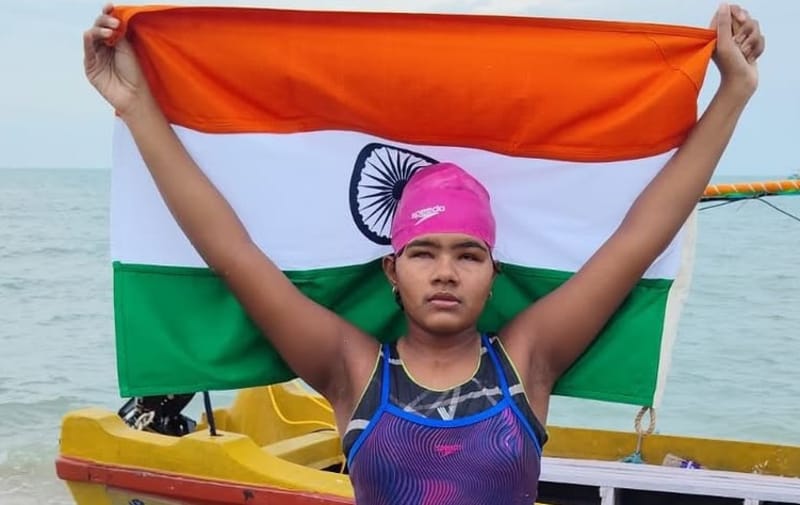
Blind But Unstoppable: The 17-Year-Old Who Conquered the Palk Strait
Under the quiet darkness of an early morning sky, when the sea is at its most unpredictable, 17-year-old Ishwari Kamalesh Pande stepped into the waters at Talaimannar, Sri Lanka. For most, the vast stretch of the Palk Strait would appear intimidating even in daylight. But for Ishwari, who was born with visual impairment, the challenge carried a different meaning. She could not see the waves rising ahead of her, nor the distant shoreline she aimed to reach. Yet, what she carried within was far more powerful than sight: an unshakable determination that would soon make history.A Journey That Began With a Simple StepIshwari’s story does not begin in the open sea but in a swimming pool in Nagpur, where she first learned to swim at the age of 10. Her parents, Kamalesh Vittal Rao Pande and Aruna Kamalesh Pande, introduced her to swimming as a basic life skill. Like any parent, their intention was simple to ensure their daughter could be safe in water. But what started as a necessity soon revealed itself as a hidden talent. Despite her visual impairment, Ishwari displayed a natural connection with water. She adapted quickly, learning to trust her body, her instincts, and the rhythm of each stroke. Recognising her growing confidence and potential, her parents and coaches encouraged her to take swimming beyond learning and into competition.Rising Through DeterminationOver the years, Ishwari began competing in national-level tournaments for visually impaired swimmers. Each competition added to her confidence, each medal strengthening her belief that her limitations did not define her. Instead of focusing on what she lacked, she focused on what she could build—strength, endurance, and discipline. Her journey was not without challenges. Swimming without sight requires immense spatial awareness and trust. Every movement must be memorised, every turn anticipated, and every stroke controlled with precision. But Ishwari embraced these challenges, turning them into stepping stones rather than obstacles.The Historic Swim Across the Palk StraitHer most defining moment came with the ambitious decision to swim across the Palk Strait, a stretch of nearly 25 kilometres between Sri Lanka and India. This route, from Talaimannar to Dhanushkodi, is known for its unpredictable currents and changing weather conditions. Even experienced swimmers approach it with caution. Ishwari began her swim at around 4 am, stepping into dark waters under challenging conditions. Strong winds and heavy rain made the beginning especially difficult. The sea was restless, and the journey ahead demanded not just physical strength but mental resilience. For over 11 hours and 15 minutes, she continued swimming, guided not by sight, but by sound, direction, and unwavering focus. Stroke after stroke, she moved forward, trusting her training and her team. By the afternoon, she reached the shores of Dhanushkodi, completing a journey that would place her name in history as the first visually impaired swimmer to cross the Palk Strait.Battling Nature and SelfThe initial phase of her swim tested her limits. Harsh weather conditions created resistance, slowing her progress and demanding greater effort. But as the hours passed, the winds shifted, offering some support to her movement. This change, however, did not lessen the magnitude of her effort. Swimming in open water is as much a mental battle as it is physical. Fatigue, uncertainty, and the endless horizon can challenge even the strongest minds. For Ishwari, these challenges were amplified by her inability to see what lay ahead. Yet, she continued, relying on her inner strength and the guidance she had practiced for years.The Role of Training and SupportBehind this remarkable achievement lies years of disciplined training and the unwavering support of her coach, Sanjay Purushothaman Padve. Training a visually impaired swimmer requires a unique approach. Movements cannot simply be demonstrated; they must be felt and understood through physical guidance. Her coach worked closely with her, guiding her hands and feet to help her internalize every stroke. This tactile method allowed Ishwari to develop a deep understanding of her movements, turning technique into instinct. Over time, her body learned to respond with precision, even without visual cues.A Story That Goes Beyond SwimmingWhat makes Ishwari’s achievement truly powerful is the human connection it creates. Her journey resonates not just with athletes but with anyone who has ever faced self-doubt or adversity. She reminds us that obstacles are not barriers, but opportunities to discover strength we did not know we had. Her story also reflects the role of family and support systems. Her parents’ decision to introduce her to swimming, her coach’s dedication to her training, and her own relentless spirit together created a path that led to history. As the waves of the Palk Strait settled behind her, they carried with them a story that will inspire generations: a story of courage, resilience, and the power of never giving up.