Her Office Has Four Wheels: Meet the Madhubani Lawyer Who Refused to Quit
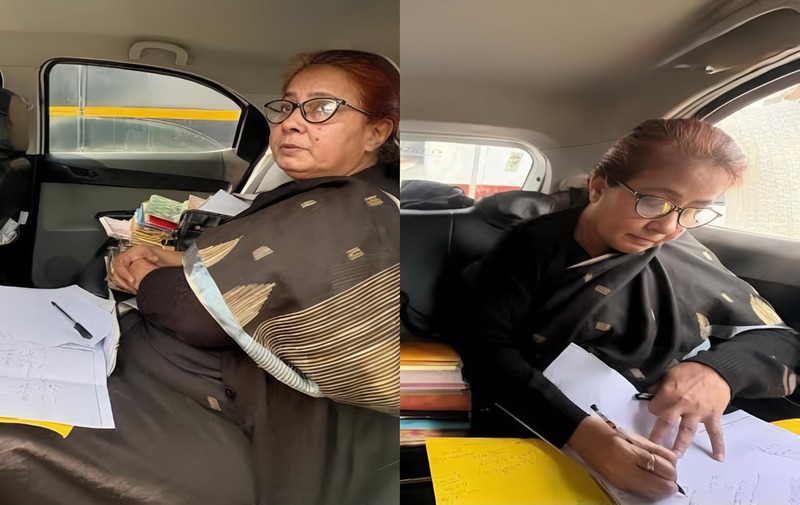
At an age when many are still figuring out careers and identities, Anita Jha was already preparing to fight two battles one in the courtroom and another just outside it. Today, in her late 50s, she stands as one of Madhubani’s most respected criminal lawyers. But her “office” is not a chamber with walls and nameplates. It is the backseat of a white hatchback parked daily inside the Madhubani District Court complex. For the last 13 years, while judges change, cases pile up, and seasons pass, Anita Jha has practiced law from her car. Not by choice. By compulsion. And by courage.A Morning Ritual That Never ChangedEvery court working day at around 10.30 am, a white hatchback enters the Madhubani District Court parking area, stopping near the jail van. Even before the engine switches off, people gather around. Clients wait with folded files, anxious faces, and quiet hope. Inside the car, seated in the rear, is Anita Jha. Files fill the seat. Legal arguments replace small talk. Discussions on bail, evidence and strategy unfold amid honking vehicles and court announcements. By evening, the car leaves silently. The “chamber” closes. From 10 am to 5 pm, this backseat becomes her workspace. For over a decade, it has functioned as her office, consultation room, and symbol of protest.Denied a Chamber, Not a ProfessionAnita Jha has practised law for more than 28 years. Yet, despite norms that allot chambers to advocates, she was never given one at the Madhubani District Court. The denial was not unique to her; it extended to other women lawyers as well. In 2011, Anita demanded a separate chamber for women advocates, a legitimate and long-overdue request. After sustained pressure, a common space was inaugurated in 2013. The celebration was short-lived. Within days, the signboard was removed. Male lawyers’ names replaced it. What followed was humiliation. Her table and chair were removed. She was mocked openly. Some colleagues dismissed her demand as the product of a “broken mind.” All of this unfolded inside the very institution meant to uphold justice.Choosing to Stay When Leaving Felt EasierBy early 2013, exhausted and isolated, Anita briefly considered leaving Madhubani. During a visit to the Maha Kumbh Mela, the thought lingered: was it worth staying in a place that refused her space? She stopped herself. Leaving, she realised, would erase her identity as a lawyer in the district. Staying, even without a chamber, would preserve it. That decision changed everything. Her car became her pratirodh her resistance. What began as a temporary arrangement turned into a daily act of defiance. She did not block gates or raise slogans. She simply showed up, every single day.Three Cars, Thirteen Years, One Unbroken ResolveAnita’s journey can be traced through the cars she worked from. In 2013, she used a pink Zen borrowed from her mother-in-law. Later came her mother’s red car. In 2022, with her own earnings, she bought the white hatchback she uses today. Each car carried her case files. Each one welcomed her clients. Each one allowed her to remain visible in a system that tried to push her out of sight. Twelve kilometres from her village Kakraul to the court, she makes the same journey every day on time, without complaint, without retreat.Becoming a Lawyer Against the OddsBorn in 1968, Anita married young but refused to give up education. She completed her BA, MA, B.Ed., and Law degrees, defying expectations at every step. In 1989, she joined law college as the only woman in her batch. Her father, who worked in the courts, encouraged her to enter the profession. Even then, she knew resistance would come. She prepared herself for it. The system delivered exactly what she anticipated and more. In 2013, the same year she lost her chamber battle, Anita lost her husband after 27 years of marriage. Many assumed grief would slow her down. Instead, it sharpened her resolve. Her empathy deepened, especially towards women navigating abuse and injustice. She practised during the early years of Section 498A and the dowry law backlash, representing women when others hesitated. Over her career, she has handled nearly 20,000 cases, including a large number under the Protection of Children from Sexual Offences (POCSO) Act.What One Car Reveals About the SystemAnita Jha’s story exposes the quiet gender bias embedded within professional institutions. Courts speak of equality, yet often fail to provide even basic facilities to women professionals. Her journey reflects how women are forced to create their own spaces when institutions deny them access. It also shows how resistance does not always roar sometimes, it simply arrives on four wheels and refuses to disappear. Thirteen years on, Anita Jha continues the same routine. She parks her car. She opens the backseat. She practises law. She does not shout. She does not withdraw. She remains present. In a system that denied her space, she created one. In a profession that tested her endurance, she stayed. Sometimes, resistance is loud. Sometimes, it is just a lawyer in a parked car showing up every day and refusing to be erased.



.jpg)