
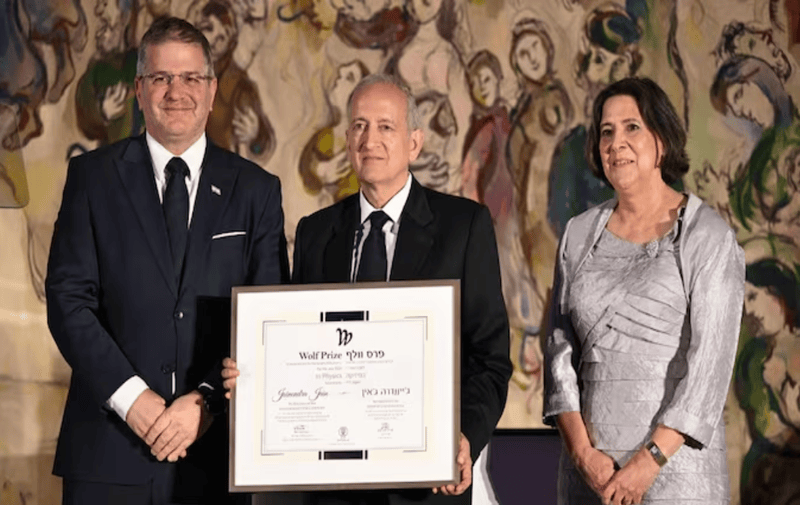
Jainendra K. Jain's Theory That Changed Quantum Physics Earns Him the Prestigious Wolf Prize
When scientists stumble upon a mystery, they spend years trying to solve it. But every once in a while, someone comes along with an idea so revolutionary that it changes the way science itself is understood. That is exactly what Indian-origin theoretical physicist Jainendra K. Jain accomplished with his celebrated composite fermion theory—a discovery that has reshaped modern condensed matter physics.In 2025, Jain's remarkable contribution earned him the Wolf Prize in Physics, making him the first physicist of Indian origin to receive one of the world's most prestigious scientific honours. Widely regarded as one of the highest recognitions in science and often seen as a precursor to the Nobel Prize, the award celebrates decades of pioneering research that continues to influence physicists around the globe.According to The Times of India, Jain's journey is as inspiring as his scientific achievements—one that began in a modest village in Rajasthan and reached the frontiers of quantum physics.The Mystery That Changed EverythingThe story dates back to the early 1980s when physicists discovered an unusual phenomenon known as the fractional quantum Hall effect. Electrons trapped inside an ultra-thin layer and exposed to extremely powerful magnetic fields began behaving in completely unexpected ways. Instead of electrical conductance appearing in whole-number values, researchers observed fractional values—something existing theories simply could not explain.For years, the phenomenon remained one of the biggest puzzles in condensed matter physics. Then came Jain's breakthrough.In 1989, he proposed an elegant yet powerful idea: under extremely strong magnetic fields, electrons bind themselves with an even number of magnetic flux quanta, creating entirely new particles known as composite fermions.As reported by The Times of India, this simple yet profound concept transformed an almost impossible many-body quantum problem into one that physicists could understand using familiar principles.The Wolf Prize, awarded every year in Israel, recognises exceptional scientists and artists for achievements that benefit humanity and promote international goodwill.A Theory That Redefined Modern PhysicsWhat initially appeared to be an innovative theoretical proposal soon became one of the most successful frameworks in quantum physics.Today, hundreds of experimentally observed quantum Hall states are explained through composite fermion theory. The scientific community even uses terms such as "Jain states" and "Jain sequences", a rare honour that reflects the enormous impact of his work.Over three decades later, researchers continue to rely on composite fermions while studying topological phases of matter, strongly correlated electron systems, anyons, and even quantum states that could one day make fault-tolerant quantum computing a reality.The enduring relevance of Jain's work is precisely why the Wolf Foundation recognised him alongside James P. Eisenstein and Mordehai Heiblum for advancing our understanding of two-dimensional electron systems in strong magnetic fields.From Rural Rajasthan to World-Class ScienceBehind this remarkable scientific journey lies an equally extraordinary personal story. Born in a poor village in Rajasthan, Jain faced enormous challenges from an early age. A serious childhood accident left him with a lifelong disability and required him to use a prosthetic limb.Despite the odds, he pursued his education through government schools before joining Maharaja College, Jaipur, followed by IIT Kanpur. He later moved to the United States, where he earned his doctorate from Stony Brook University and eventually became the Erwin W. Müller Professor of Physics at Pennsylvania State University.According to The Times of India, Jain has often acknowledged the life-changing role played by the Jaipur Foot, which helped him regain mobility and continue his academic journey.More Than an AwardThe Wolf Prize celebrates more than a remarkable scientific theory. It honours a lifetime of curiosity, perseverance and fearless thinking. Jain's composite fermion theory remains central to cutting-edge research in quantum matter.For India, his recognition represents a historic milestone in global science. For the world of physics, it serves as a reminder that transformative discoveries often begin with one simple question—and the courage to challenge conventional wisdom.