
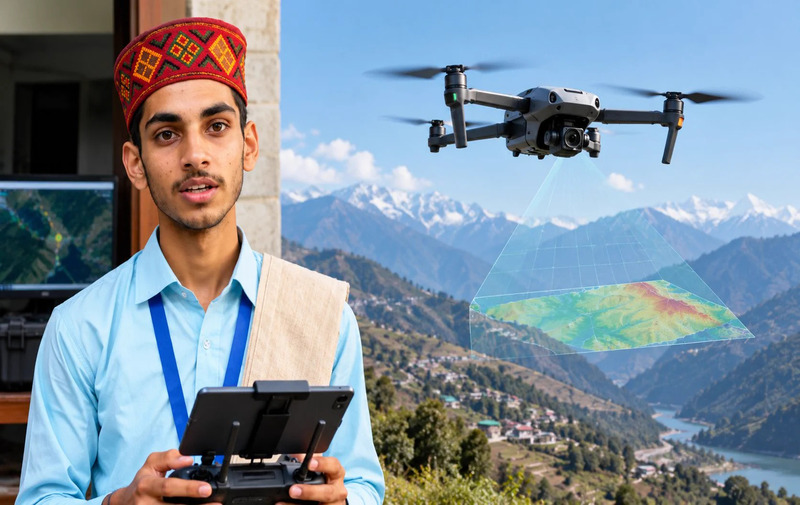
Labourer’s Son Secures ₹3.5 Crore Defence Grant to Build Drone for Indian Army
For Sarvesh Sharma, a fifth-semester computer engineering student from Government Polytechnic, Hamirpur, the journey from a modest prototype to a major defence project has been remarkably fast.The son of a daily-wage labourer, Sharma has secured a ₹3.5 crore grant from the Union Ministry of Defence to develop an indigenous surveillance drone for the Indian Army. His project, Rudra Edge T-1 (Spectra), is being developed under the Defence Innovation Organisation’s (DIO) Innovations for Defence Excellence (iDEX) initiative.The drone is being designed for surveillance in challenging mountainous and high-altitude border areas.Sharma’s big break came through a national-level drone competition organised by IIT Jodhpur and the Konark Corps. His team competed against around 50 teams from premier institutions across India in the Open Cardboard Drone Competition and secured fourth place, along with a ₹10 lakh cash prize.The experience inspired Sharma to take his idea further. He eventually spent ₹87,000 of his own resources to develop an initial prototype and prepare a startup proposal. He then submitted the proposal to the Defence Ministry under its individual innovation framework.The proposal was approved, opening the door to a much larger defence project.A Drone Built for Tough TerrainThe Rudra Edge T-1 (Spectra) is being developed with the demanding conditions of high-altitude surveillance in mind. Sharma and his team have said the UAV is intended to reduce the chances of detection by enemy radar and withstand electronic jamming attempts.However, these capabilities will have to be established through development and testing. The project has a 20-month completion target. If successful, the drone could offer a specialised indigenous solution for surveillance in some of the country's most difficult terrains.IIT Roorkee Joins the JourneyThe project will receive technical support through an incubation centre at IIT Roorkee. Sharma will have access to laboratories and professional mentorship as development progresses.For a student from Bahanvi village, this marks a remarkable transition—from building a ₹87,000 prototype with limited resources to working on a ₹3.5 crore defence innovation project.Himachal Pradesh Governor Kavinder Gupta also felicitated Sharma for the achievement, highlighting its contribution to India’s efforts to develop indigenous defence technologies. Sarvesh’s story shows how a big idea, even when it begins with limited resources, can find its way into the country’s most ambitious innovation programmes.