
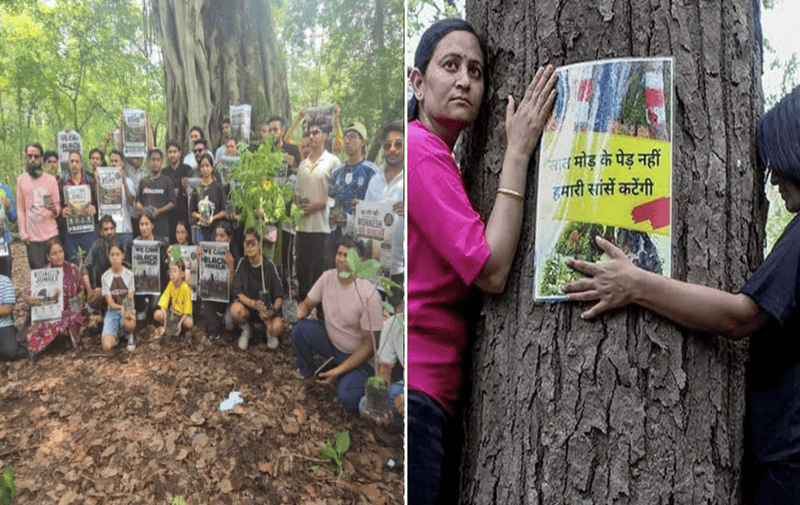
People Power Saves Dehradun's Green Gateway: Uttarakhand Pauses Felling of Over 4,000 Trees
In a significant victory for environmental conservation and public participation, the Uttarakhand government has temporarily halted the proposed felling of thousands of trees along Dehradun's iconic Saat Mod forest stretch. The decision came after mounting protests from residents, environmentalists and civil society groups, who urged authorities to rethink plans that threatened one of the city's most cherished green corridors.Responding to the growing outcry, Chief Minister Pushkar Singh Dhami announced that tree-felling for the Bhaniyawala-Rishikesh four/six-lane highway project would remain suspended until fresh consultations are held with residents, experts, environmentalists and other stakeholders.Sharing the announcement on X, the Chief Minister emphasised that while infrastructure development remains essential, it cannot move forward at the expense of public sentiment, environmental concerns or local interests. The project, he said, will proceed only after a broad consensus is achieved.Saat Mod: Dehradun's Green GatewayKnown as "Seven Bends," Saat Mod is much more than a scenic stretch of road. Located along National Highway-7 between Bhaniyawala and Rishikesh, the route is lined with towering sal trees that form a lush canopy welcoming visitors into Dehradun.The forest is also an ecologically sensitive landscape. It lies along an important elephant movement corridor and supports a rich diversity of wildlife, including deer, monkeys, birds and countless smaller species. For many residents, Saat Mod represents one of the Doon Valley's last remaining natural buffers against rapid urbanisation.Its environmental importance has made it a symbol of the larger struggle to preserve Uttarakhand's forests while accommodating the state's growing infrastructure needs.The Highway Project at the Centre of DebateThe controversy revolves around the ₹743-crore Bhaniyawala-Jolly Grant-Rishikesh highway widening project being undertaken by the National Highways Authority of India (NHAI). Covering nearly 20 kilometres, the project aims to improve connectivity between Dehradun, Rishikesh and Jolly Grant Airport while easing congestion during the Char Dham Yatra.According to NHAI, the existing two-lane highway handles nearly 18,500 vehicles every day, with traffic expected to increase significantly in the coming years. Officials say the expanded highway will improve road safety, reduce travel time and support tourism and economic growth.However, the project sparked intense criticism after plans revealed that 4,369 trees would be affected, including 3,605 slated for felling and 754 proposed for transplantation.A Forest Worth ProtectingThe protests gained nationwide attention during Uttarakhand's annual Harela festival, traditionally dedicated to celebrating trees and nature. Instead of festivities, environmental groups observed "Black Harela," gathering at Saat Mod to demand alternative solutions that could protect the forest.Experts argue that the issue extends far beyond counting trees. Mature sal forests regulate local temperatures, store carbon, prevent soil erosion, recharge groundwater and sustain intricate ecosystems built over decades. Once fragmented, these natural systems may require generations to recover.The forest also plays a critical role in maintaining wildlife connectivity. Conservationists warn that disturbing the elephant corridor could increase human-animal conflict while disrupting the movement of several species that depend on uninterrupted forest landscapes.Although NHAI says the project includes mitigation measures based on recommendations from the Uttarakhand Forest Department, WWF-India and the Wildlife Institute of India, many experts continue to advocate for alternative alignments or additional safeguards.A Defining Moment for Sustainable DevelopmentFor now, the chainsaws have fallen silent, but the larger conversation has only just begun. The government's decision to reopen consultations marks an important reminder that development and environmental conservation need not be opposing goals. As legal proceedings continue and stakeholders return to the discussion table, the future of Saat Mod could shape how infrastructure projects are planned across India's ecologically fragile Himalayan states.The outcome may ultimately become a landmark example of how public participation, scientific expertise and responsible governance can work together to protect both progress and the planet.