
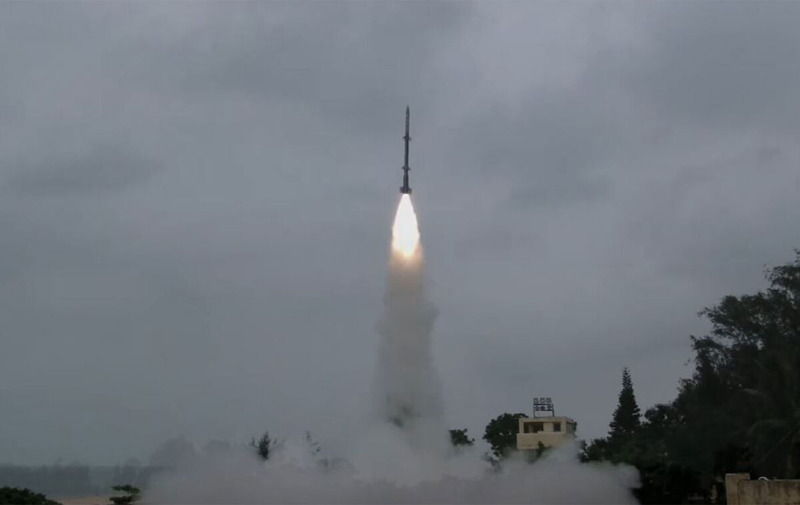
India's Air Shield Gets Stronger! DRDO Successfully Tests Indigenous Kusha Missile
India has taken another giant stride towards strengthening its defence capabilities. The Defence Research and Development Organisation (DRDO) successfully conducted the maiden flight test of the indigenous Kusha long-range surface-to-air missile (LRSAM) from Dr APJ Abdul Kalam Island off the Odisha coast, marking a significant milestone in the country's quest for self-reliance in defence technology.The successful test is a major boost for Project Kusha, India's ambitious indigenous air defence programme that aims to provide a powerful shield against a wide range of aerial threats while reducing dependence on imported systems.A Powerful Indigenous Air Defence SystemThe Kusha missile has been designed to defend India against an extensive range of airborne threats.Once fully operational, it will be capable of intercepting fighter aircraft, unmanned aerial vehicles (UAVs), cruise missiles, precision-guided weapons, large enemy aircraft and even certain categories of ballistic missile threats across long distances and varying altitudes.Defence Minister Rajnath Singh hailed the successful test as a landmark achievement for India's defence research ecosystem. He noted that only a handful of nations possess the capability to develop long-range surface-to-air missile systems of this class. According to him, the achievement will significantly reduce India's reliance on imported strategic air defence systems while strengthening the nation's security.The successful test also reflects the government's continued emphasis on the Atmanirbhar Bharat initiative, encouraging indigenous design, development and manufacturing of advanced defence technologies.The Vision Behind Project KushaProject Kusha is envisioned as the backbone of India's future long-range air defence network. As per a report in The Times of India, the system is being developed as a three-tier missile architecture featuring M1, M2 and M3 interceptor missiles, with engagement ranges of approximately 150 km, 250 km and up to 350–400 km, respectively.This layered defence structure will enable India to detect, track and neutralise multiple airborne threats simultaneously across different distances and altitudes.The system is also expected to integrate seamlessly with the Indian Air Force's Integrated Air Command and Control System (IACCS), enabling real-time surveillance and coordinated responses against incoming threats.Building India's Future Missile ShieldProject Kusha is expected to play a central role in Mission Sudarshan Chakra, India's long-term vision of establishing a comprehensive national air and missile defence shield by 2035. According to The Times of India, the proposed defence architecture will combine long-range interceptors with quick reaction surface-to-air missile systems, very short-range air defence platforms, directed energy weapons and indigenous ballistic missile defence capabilities.Together, these technologies are expected to create one of the world's most sophisticated multi-layered air defence networks. The successful maiden flight test marks only the beginning of Kusha's journey. Following additional developmental trials, the missile system is expected to move towards induction into the Indian Armed Forces.As global security challenges continue to evolve, the successful development of indigenous systems like Kusha highlights India's growing technological expertise and determination to safeguard its skies with home-grown innovation. More importantly, it reinforces the nation's emergence as a global leader in advanced defence research, ensuring that India's future air defence rests increasingly in its own hands.