
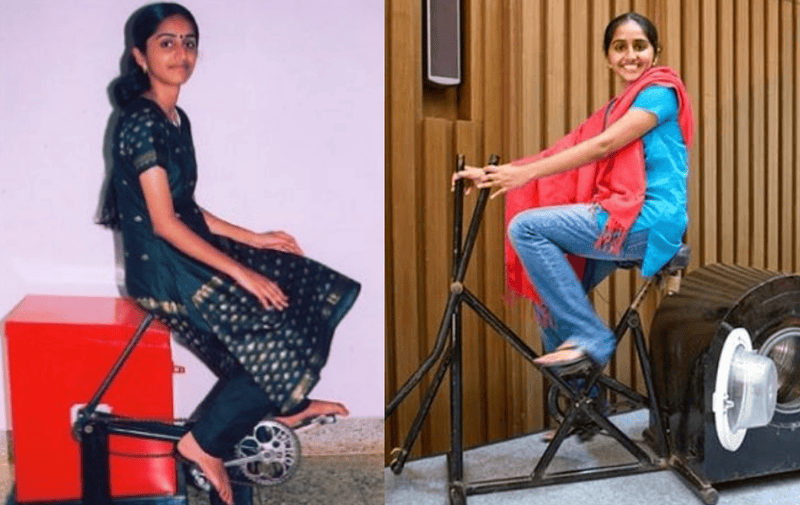
Laundry Was Stealing Her Study Time. So This 14-Year-Old Built a Pedal Powered Washing Machine!
In 2005, while most 14-year-olds in Kerala were worrying about their Class 10 board exams, Remya Jose was juggling something far more demanding.Her mother was ill, her father was undergoing cancer treatment, and the daily household laundry had fallen on Remya and her twin sister. On top of that, Remya’s school commute took nearly four hours a day, involving three buses.Hand-washing clothes consumed even more of her precious time. But instead of accepting the situation, the teenager asked a deceptively simple question: What if she could build a washing machine herself?She had no engineering degree, no expensive laboratory and no electricity-powered appliance to start with. What she had was curiosity—and a bicycle.The Making of a Washing MachineRemya began studying how an ordinary washing machine worked. She realised that its basic function was surprisingly straightforward: clothes needed to be agitated in soapy water, rinsed and spun dry.The electric motor provided the rotation. So why not replace the motor with something much simpler? Pedalling.Her idea involved an aluminium outer structure containing a wire-mesh cylinder. A bicycle’s pedals, chain and sprockets were connected to the drum so that pedalling would make it rotate.Her father took her sketch to a nearby automobile workshop. Mechanics helped turn the teenager’s idea into a working machine, using locally available materials costing around ₹2,000. And remarkably, it worked.Three Steps, One Ingenious IdeaThe machine operated through a simple washing cycle. First, clothes were soaked in soapy water for around ten minutes. Then Remya would sit on the bicycle seat and pedal for about three to four minutes, rotating the inner drum and agitating the clothes.After the dirty water was drained, fresh water was added for rinsing. Finally, with the water drained, another round of pedalling spun the drum rapidly, helping remove water from the clothes and leaving them around 80 per cent dry.The invention didn't need electricity. It also provided something unexpected: exercise while doing the laundry.From a Teenager’s Idea to a National AwardInitially, even Remya’s parents wondered whether the project was worth the time and effort. But when the machine began saving hours of household work, its value became impossible to ignore.The National Innovation Foundation (NIF) recognised Remya’s grassroots innovation and documented the invention as the “Washing Cum Exercise Machine.”Her remarkable idea eventually earned her a National Award, presented by then-President Dr A.P.J. Abdul Kalam. For a teenager who had simply wanted to reclaim some time for her studies, the recognition was extraordinary.An Idea Born From NecessityRemya’s story is a powerful reminder that innovation doesn't always begin with sophisticated technology. Sometimes, it begins with a teenager looking at an ordinary problem and refusing to say, “This is just the way things are.”With a bicycle, a few mechanical components and a lot of determination, a 14-year-old girl transformed a tedious chore into an ingenious off-grid machine.Her invention wasn't merely about washing clothes. It was about reclaiming time—and proving that age, resources and circumstances don't have to decide who gets to innovate.