
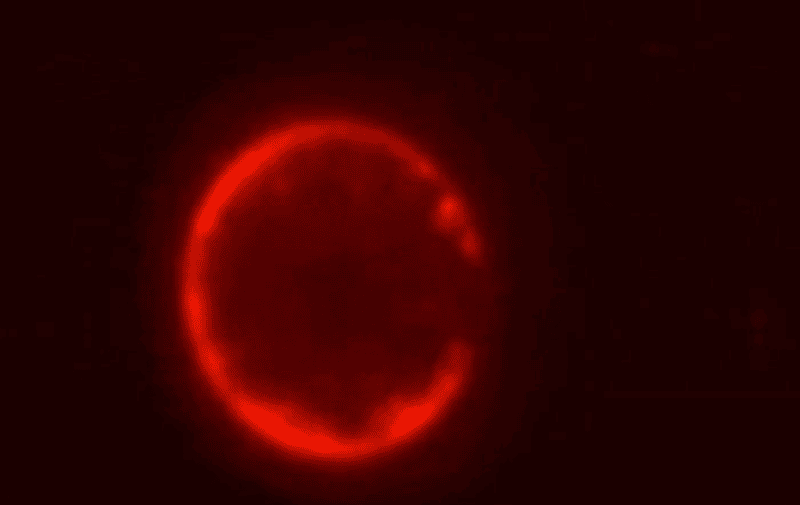
A World First: Scientists Create a Synthetic Cell That Can Replicate
In a remarkable scientific breakthrough, researchers have successfully built a synthetic cell from scratch—one capable of feeding and replicating much like a natural cell.Developed entirely from non-living chemical components, the achievement marks a major milestone in the rapidly evolving field of synthetic biology. While the newly created cell is still simple and fragile, scientists believe it represents a giant step toward designing custom-built living systems that could one day fight diseases, manufacture useful chemicals or even help tackle climate change.Far from being "artificial life," the achievement demonstrates that scientists are moving closer to understanding one of humanity's oldest questions: How does life begin?Meet 'SpudCell'—A Tiny Cell with Big PotentialAccording to a report by CNN, the pioneering work was led by Kate Adamala, a synthetic biologist and professor at the University of Minnesota. Her team painstakingly assembled the cell molecule by molecule, creating a fully defined organism whose ingredients are completely known. Unlike naturally occurring cells, whose complexity often makes them difficult to understand, this synthetic cell has no hidden components."I know the full ingredient list of the cell," Adamala explained. "It is fully defined, which means we can engineer it." Nicknamed “SpudCell,” the tiny organism is neither plant nor animal. Instead, it most closely resembles a simple bacterium. Unlike natural cells, SpudCell reproduces using an entirely different mechanism. Rather than relying on a cellular skeleton to divide, proteins accumulate around its membrane until the cell splits into two. It is, however, still dependent on borrowed machinery. SpudCell cannot yet produce its own ribosomes, the molecular factories that build proteins, and instead relies on ribosomes supplied from E. coli during feeding.Adamala jokingly described her creation as "an incredibly wimpy organism" because, for now, its only abilities are eating and occasionally producing a daughter cell.Why This Breakthrough MattersAccording to CNN, for decades, scientists have modified existing cells to solve human problems. One of the best-known examples is inserting human insulin genes into E. coli bacteria, enabling the large-scale production of insulin used to treat diabetes.Synthetic cells take that concept a step further. Instead of reprogramming nature, researchers can begin designing biological systems entirely from scratch, free from the evolutionary constraints found in natural organisms. Experts believe this could eventually revolutionise medicine, enabling new cancer therapies, cleaner chemical manufacturing, carbon capture technologies and highly specialised biological tools that do not currently exist in nature.A New Frontier in Synthetic BiologyScientists emphasise that SpudCell is not life created in a laboratory, but rather a proof-of-concept demonstrating that non-living chemicals can be organised into a system that behaves like a living cell. Independent experts have hailed the achievement as a genuine milestone in synthetic biology and a significant step towards understanding how chemistry transitions into life.For Adamala, this is only the beginning. She said that it is a chassis that they hope to build on.As researchers continue refining synthetic cells, today's fragile prototype could become tomorrow's programmable biological machine—transforming medicine, environmental conservation and biotechnology in ways that were once confined to imagination.