
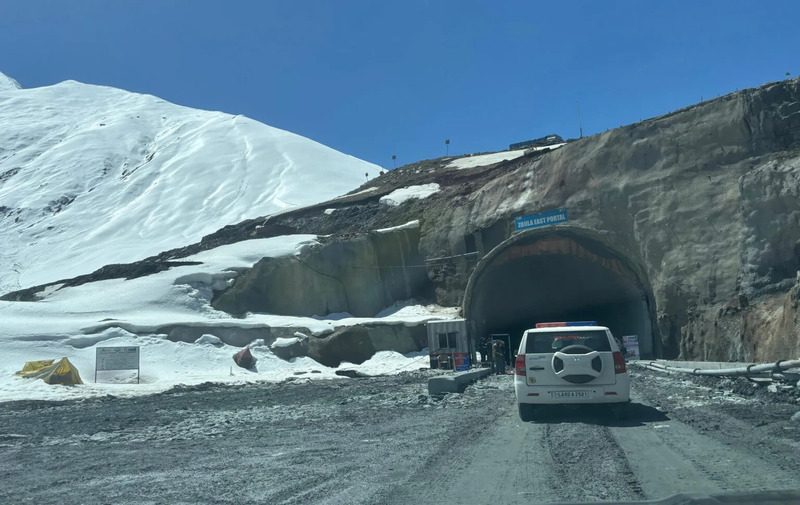
A New Lifeline for Ladakh: World's Longest Bi-Directional Tunnel Nears Completion
A deafening blast echoed through the Himalayas on Tuesday, marking a historic moment in India's infrastructure journey. Deep beneath the rugged mountains of Zojila, engineers achieved the final breakthrough of the Zojila Tunnel, a project that promises to transform connectivity between Kashmir and Ladakh forever.Once completed, the tunnel will become the world's longest single-tube bi-directional road tunnel at an altitude of over 11,500 feet, turning a route that remains inaccessible for months each winter into an all-weather lifeline.The breakthrough ceremony was attended by Union Minister for Road Transport and Highways Nitin Gadkari, who triggered the final blast remotely near the tunnel's eastern portal at Minimarg in Ladakh. Jammu and Kashmir Lieutenant Governor Manoj Sinha and Chief Minister Omar Abdullah were also present for the landmark occasion.Breaking Through the MountainsAt approximately 13.15 kilometres in length and situated at an elevation of around 11,578 feet above sea level, the Zojila Tunnel is one of the most ambitious engineering projects ever undertaken in India. The final breakthrough occurred when a 2.5-metre rock wall separating the two ends of the tunnel was blasted away, allowing the passage to connect from end to end for the first time.The moment marked the successful completion of one of the most challenging excavation phases of the project, which has been under construction since October 2020. Officials described the achievement as arriving six months ahead of schedule, underscoring the speed and efficiency with which the project has progressed despite difficult terrain and extreme weather conditions.A Lifeline for LadakhFor decades, the Zojila Pass has been both a gateway and a barrier. Heavy snowfall frequently shuts down the Srinagar-Leh highway for nearly six months each year, leaving Ladakh isolated from the rest of the country and creating hardships for residents, businesses, tourists, and essential services.The tunnel is expected to change that reality. Once operational, it will ensure uninterrupted connectivity between Kashmir and Ladakh throughout the year, dramatically improving transportation, trade, healthcare access, and economic opportunities for communities living in the region.Speaking at the ceremony, Gadkari described the breakthrough as a golden chapter in India's infrastructure story and emphasized that the tunnel would serve as a crucial lifeline for Ladakh. He also highlighted that the project incorporates world-class safety features and advanced engineering technologies.Engineering a Himalayan MarvelBuilding a tunnel through the fragile Himalayan mountain range was never going to be easy. Constructed by Hyderabad-based Megha Engineering & Infrastructure Limited (MEIL), the project utilized the New Austrian Tunnelling Method (NATM), a sophisticated construction technique designed specifically for complex geological conditions.Engineers faced unpredictable rock formations, extreme temperatures, and challenging terrain while working at high altitudes. Yet the project steadily advanced in one of the world's most difficult environments. An MEIL executive described the breakthrough as a defining milestone that showcased the successful execution of one of India's most complex transportation projects.The region's proximity to the borders with Pakistan and China makes rapid troop movement and reliable logistics essential. The tunnel will allow military personnel, equipment, and supplies to move more efficiently and safely throughout the year, strengthening India's preparedness in a strategically important frontier corridor.The Road AheadWhile the breakthrough marks a major milestone, work on the tunnel is not yet complete. Civil construction is expected to continue for several more months before electrical and operational systems are installed. According to officials, the tunnel is likely to open to the public in early 2028.When that day arrives, the Zojila Tunnel will stand as more than just an engineering achievement. It will symbolize India's determination to conquer geographical challenges, connect remote communities, and bring one of the country's most isolated regions closer to the rest of the nation.