
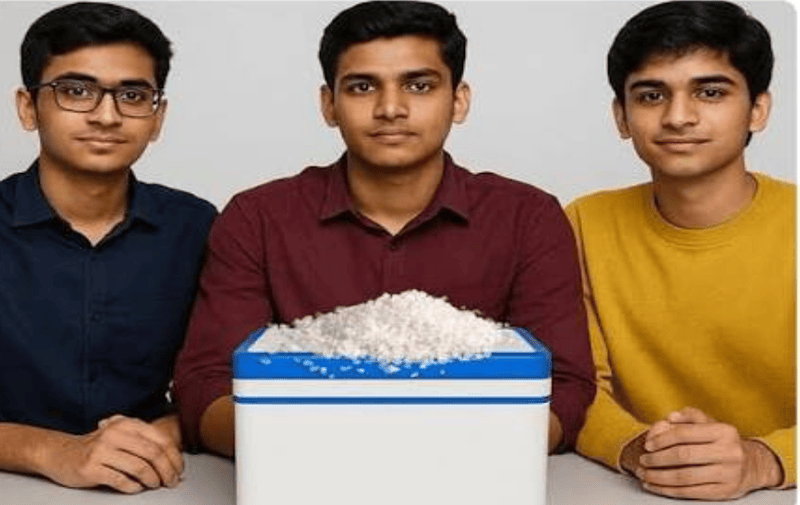
No Ice, No Electricity: This Salt-Powered Vaccine Box Won 3 Indian Teens the Earth Prize
A vaccine may be ready to save a life, but what happens when the nearest village has no reliable electricity to keep it cold?That question became deeply personal for three teenagers in Indore—Dhruv Chaudhary, Mithran Ladhania and Mridul Jain. Their parents, all working in medicine, had seen the problem up close during the COVID-19 pandemic: vaccines could reach rural areas, but maintaining the required temperature over long distances was another challenge altogether.The teenagers decided to tackle that gap themselves. Their answer was Thermavault, an insulated cooling box that needs neither electricity, batteries nor ice. Instead, it uses a simple chemical principle—and salt—to create the cold.From a Science Textbook to a Working PrototypeThe journey began with research. The trio studied around 150 different salts available through online resources before narrowing their list to about 20 salts. They then borrowed laboratory facilities at the Indian Institutes of Technology (IITs) to test them. But the experiments didn't produce the temperatures they needed.The breakthrough came from an unexpected place: a ninth-grade science textbook. Their teacher pointed them towards ammonium chloride and barium hydroxide octahydrate, compounds known for producing a cooling reaction when mixed appropriately. The teenagers discovered that ammonium chloride could maintain temperatures between 2°C and 6°C, a range suitable for many vaccines.Adding barium hydroxide octahydrate could push temperatures below zero, potentially opening possibilities beyond vaccines, including organ transport. Within three months of finding the right formulation, the teenagers had developed a working prototype and begun hospital testing in Indore.How Thermavault Creates Cold Without IceThermavault may look simple, but its science is clever. According to a report in The Times of India, the box has an insulated plastic exterior and a copper lining inside. Between the two sits a cooling solution made by dissolving selected salts in water. When the salts dissolve, they absorb energy from their surroundings, producing a cooling effect.During hospital testing, Dr Pritesh Vyas, an orthopedic surgeon at V One Hospital in Indore, said vaccines had remained inside Thermavault for around 10 to 12 hours. He also suggested that refinements such as an integrated temperature monitor could make the device even more useful in remote villages.A Global Prize for a Local IdeaThe innovation earned the teenagers the 2025 Earth Prize for Asia, an international recognition for young people developing environmental solutions. The award came with $12,500, which the trio planned to use to build around 200 Thermavault units and test them across 120 hospitals.They also hoped to pursue Performance, Quality and Safety (PQS) certification through the World Health Organization (WHO), an important step if they are to eventually approach global vaccine-distribution networks such as Gavi. For the teenagers, however, the idea began much closer to home.They saw their parents confronting a problem during a global crisis. They searched, experimented, failed, went back to a school textbook—and found an answer. Now, a small salt-powered box from Indore could have the potential to help bridge one of healthcare's most stubborn gaps: keeping life-saving vaccines cold, even where the power grid cannot reach.