
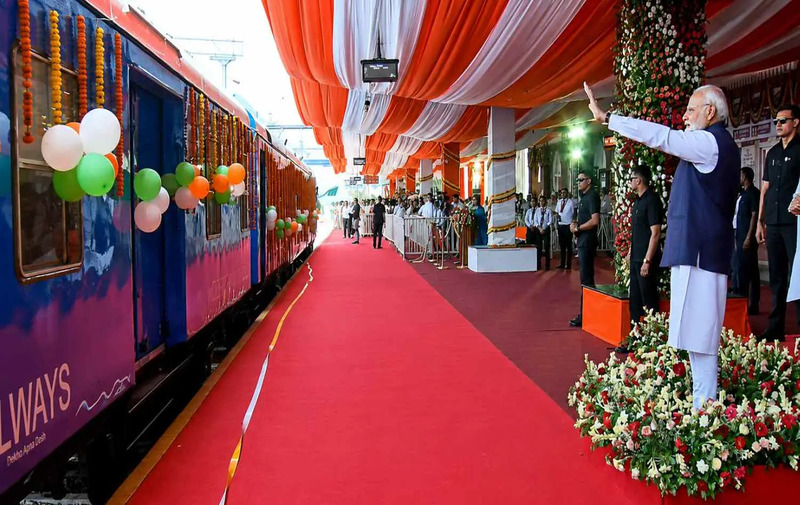
PM Modi Flags Off India's First Hydrogen-Powered Train
India has taken a giant leap into the future of sustainable transportation. Prime Minister Narendra Modi flagged off the country's first hydrogen-powered train from Jind railway station in Haryana on Friday, placing India among a select group of nations pioneering hydrogen-powered rail travel.The launch is more than just another train inauguration, it represents India's ambitious push towards cleaner, greener mobility. As the world searches for sustainable alternatives to fossil fuels, hydrogen has emerged as one of the cleanest energy sources, producing nothing more than water vapour during operation.With this milestone, Indian Railways has introduced the world's longest hydrogen-powered passenger train, entirely designed, engineered and integrated using indigenous technology.A Global Milestone on Indian TracksHydrogen-powered trains remain a rarity worldwide. Only a handful of countries, including Germany, Japan, China and the United States, have commercially deployed or tested the technology.India now proudly joins this elite club with a train that raises the global benchmark. Unlike most hydrogen trains operating internationally with just two or three passenger coaches, India's version boasts an impressive 10-coach configuration, making it the longest hydrogen-powered passenger train of its kind in the world.Equipped with a powerful 3,200-horsepower propulsion system, the train can carry up to 2,600 passengers. While its design speed is 110 kmph, it will operate at a maximum speed of 75 kmph on the pilot route.The Jind-Sonipat Pilot CorridorThe hydrogen train will operate under Northern Railways between Jind and Sonipat in Haryana, serving as a pilot project for Indian Railways.Train number 74010 departs from Jind daily at 7:40 AM, reaching Sonipat at 9:40 AM after a two-hour journey. The return service, train number 74009, leaves Sonipat at 10:40 AM and arrives in Jind at 1:00 PM, taking approximately two hours and twenty minutes.Along the route, passengers will travel through stations including Jind City, Pandu Pindara, Lalit Khera, Bhambeva, Ishapur Kheri, Butana, Khandrai, Gohana, Rabhra, Lath, Mohana Haryana and Barwasni. The train's primary maintenance facility will also be located in Jind.How Does a Hydrogen Train Work?Unlike conventional electric trains that depend on overhead power lines or diesel locomotives that burn fossil fuels, this train generates electricity onboard through Proton Exchange Membrane (PEM) fuel cell technology.Hydrogen stored in cylinders reacts with oxygen from the surrounding air inside the fuel cells. This electrochemical reaction produces electricity, which powers the train's traction motors. Remarkably, the only direct by-products are water vapour and heat, eliminating smoke, combustion and carbon emissions.According to a report in The Times of India, the train consists of two hydrogen-powered driving cars and eight trailer coaches. Each power car houses hydrogen fuel cells, hydrogen storage cylinders and lithium iron phosphate batteries, working together to provide efficient and clean propulsion.Driving Towards a Greener FutureIndian Railways has already transformed its energy landscape over the past decade by electrifying more than 99% of its broad-gauge network, significantly reducing dependence on imported diesel.However, hydrogen technology offers a promising solution for routes where conventional electrification may not be practical, especially remote and heritage railway lines. The Jind-Sonipat project will provide valuable operational experience before the technology is expanded further.As India accelerates its clean energy transition, the hydrogen train stands as a symbol of innovation, self-reliance and environmental responsibility. From indigenous engineering to zero-emission mobility, this historic launch signals that the future of Indian railways is not only faster, but also greener.