
Gajraj Suraksha: How Technology Is Making India's Railway Tracks Safer for Elephants
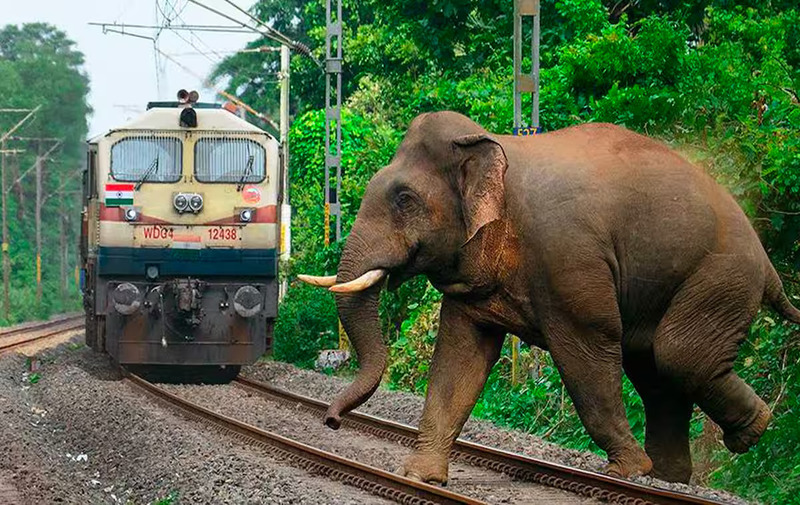
India is home to nearly 60% of the world's Asiatic elephants, making it one of the most important countries for elephant conservation. Yet, despite having more than 32 elephant reserves, these majestic giants continue to face growing threats from human activity.Among the biggest dangers are railway tracks. After electrocution, train collisions are the second leading cause of unnatural elephant deaths in India. Now, Indian Railways is turning to artificial intelligence to change that story.Introducing Gajraj SurakshaIn a major leap for wildlife conservation, Indian Railways had launched Gajraj Suraksha, an AI-powered surveillance system designed to prevent elephants from being struck by trains. Following successful field trials in Assam, the Railway Ministry has announced that the technology will now be deployed across nearly 700 kilometres of railway lines passing through elephant habitats in Assam, West Bengal, Odisha, Kerala, Jharkhand, Chhattisgarh and Tamil Nadu.The ambitious project, estimated to cost ₹181 crore, is expected to become one of India's largest AI-driven wildlife protection initiatives. Railway officials say continuous improvements based on field experience have enabled the system to identify elephants with an impressive 99.5% accuracy, making it a powerful tool for preventing collisions.How AI Detects Elephants Before Trains DoWhat makes Gajraj Suraksha remarkable is that it uses infrastructure already present along railway tracks. The system is built on the optical fibre cables installed for railway communication and signalling. Whenever an elephant walks close to the tracks, its movement creates vibrations that disturb the light signals travelling through the fibre-optic network.Artificial intelligence instantly analyses these disturbances and distinguishes whether they are caused by elephants, humans or other animals.If an elephant is detected within approximately 200 metres of the railway line, the system immediately sends real-time alerts to the station master, train controller, locomotive pilot and other railway officials. This gives train drivers valuable time to slow down or stop before reaching the animal.The technology can detect elephant movement up to five metres from the optical fibre cable, allowing authorities to respond quickly.A Proven Success in the NortheastThe technology has already demonstrated promising results. The Northeast Frontier Railway (NFR) introduced the Intrusion Detection System in 11 elephant corridors across Alipurduar and Lumding divisions in 2022. Since its implementation, officials have reported the elimination of elephant deaths due to train accidents in these monitored corridors.The encouraging outcome paved the way for the nationwide expansion of Gajraj Suraksha.India has increasingly embraced technology to improve railway safety, from the Kavach anti-collision system for trains to AI-powered monitoring tools.Gajraj Suraksha takes that vision a step further by extending the benefits of innovation beyond passengers to wildlife. As forests shrink and railway networks expand, balancing development with conservation has become more important than ever. By combining artificial intelligence with existing railway infrastructure, Indian Railways is demonstrating that technology can play a vital role in protecting both lives and biodiversity.If its success continues, Gajraj Suraksha could become a global model for using AI to safeguard wildlife while keeping one of the world's busiest railway networks moving safely.