
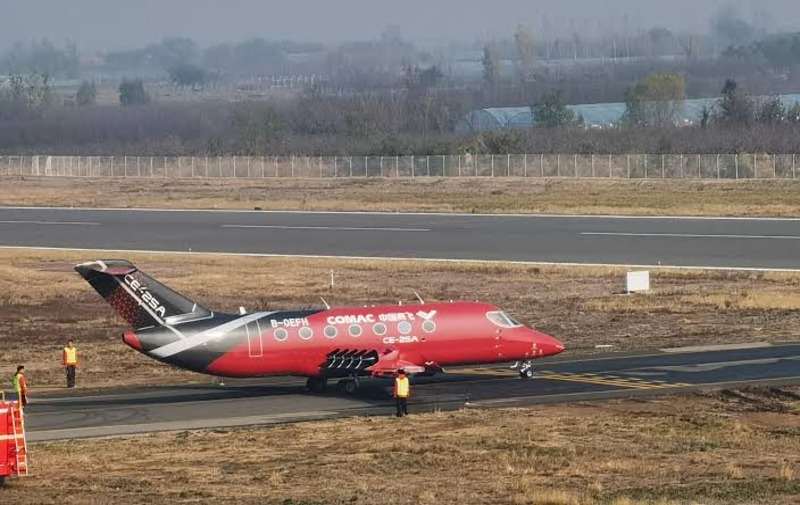
A New Era in Aviation! China Flies World's First 10-Tonne-Class Electric Commercial Aircraft
Imagine boarding a passenger aircraft that takes off without burning a drop of conventional aviation fuel! China has taken a significant step towards making this vision a reality by successfully flying its 10-tonne-class battery-electric commercial aircraft, the CE-25A, with a crew on board.The aircraft completed its maiden crewed flight on Saturday in Binzhou, in China's eastern Shandong province, marking a major milestone in the development of electric aviation. According to China's state-owned broadcaster CCTV, the aircraft carried two pilots and one flight-test engineer during the historic flight.The development could open new possibilities for cleaner, quieter and more sustainable air travel.A Major Milestone for Electric AviationDeveloped through a collaboration involving Chinese aerospace manufacturer Commercial Aircraft Corporation of China (COMAC), battery maker CATL, Shanghai Jiao Tong University and other partners, the CE-25A is designed to operate entirely on battery-electric power.Before its first crewed flight, the aircraft had successfully completed 19 unmanned autonomous flight validations. The latest test marked another important step towards its certification and eventual commercial use.The Civil Aviation Administration of China has also accepted COMAC's application for a type certificate, an important regulatory milestone in the aircraft's development. COMAC reported that the aircraft operated normally during the test, with its performance indicators meeting expectations.What Makes the CE-25A Special?Designed primarily for intercity commercial travel, the CE-25A comes with specifications that highlight the potential of battery-powered aviation. According to China's CCTV, the aircraft has a cruising speed of 300 km per hour, a cruising altitude of 2,400 metres and an estimated range of 400 km.The test session lasted 57 minutes and 46 seconds, although the aircraft spent just over 16 minutes airborne. It covered a distance of 60.4 km during the flight. Unlike conventional aircraft that rely on aviation turbine fuel (ATF), the CE-25A uses battery-electric propulsion, potentially reducing operational emissions and dependence on fossil fuels.From Early Experiments to Commercial PossibilitiesElectric aviation is not entirely new. Austria's Militky MB-E1, a motor glider, is recognised as the first full-size electric aircraft to fly with a person on board in 1973. Other companies have also explored this technology. Israel-developed Eviation Alice, for instance, was designed as a nine-passenger electric aircraft, although its development has not progressed to commercial operations.What makes China's CE-25A particularly significant is its 10-tonne-class design and 19-seat commercial passenger aircraft configuration. With this successful crewed flight, China has taken another step towards expanding the possibilities of electric aviation. As countries explore ways to reduce aviation's environmental footprint, developments like the CE-25A could inspire more innovations in sustainable air travel.The future of flying may not just be about reaching destinations faster. It could also be about getting there with a lighter environmental footprint!