
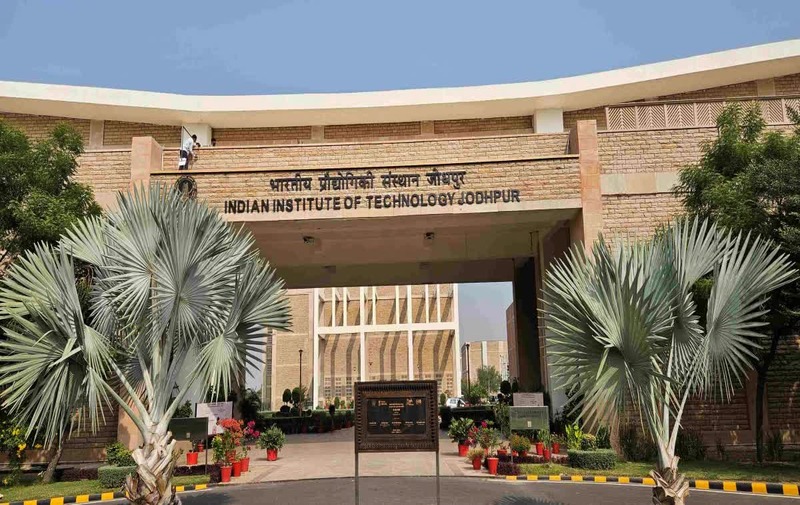
IIT Jodhpur Becomes Full Member of CERN's CMS Collaboration, the World's Largest Particle Physics Laboratory
India has added another remarkable chapter to its scientific journey. In a proud achievement for the country, the Indian Institute of Technology (IIT) Jodhpur has secured full-time membership in the Compact Muon Solenoid (CMS) collaboration at CERN, the world's largest particle physics laboratory in Geneva, Switzerland.The milestone places the Rajasthan-based institute among an exclusive league of top universities and research organisations working on some of the biggest mysteries of the universe. It also strengthens India's growing presence in international scientific collaborations that are shaping the future of physics, technology and artificial intelligence.Sharing the announcement on X, IIT Jodhpur described the development as "a proud milestone for India," highlighting its role in advancing frontier research at the Large Hadron Collider (LHC) under the leadership of Dr Lata Panwar and Dr Jitendra Kumar.A Seat at the World's Biggest Science TableThe CMS collaboration is one of the flagship experiments at CERN, home to the Large Hadron Collider—the most powerful particle accelerator ever built. Scientists from across the globe use the LHC to recreate conditions that existed fractions of a second after the Big Bang, helping answer fundamental questions about how the universe was formed and what it is made of.With its new status as a full member, IIT Jodhpur will directly participate in the CMS collaboration's long-term scientific programme. Researchers from the institute will contribute to groundbreaking studies in particle physics, design advanced detector technologies and develop artificial intelligence and machine learning tools capable of processing the enormous volume of data generated during high-energy particle collisions.The institute noted that its contributions will span fundamental physics, detector development and scientific computing—three pillars of modern experimental physics.Led by Scientists with Global RecognitionThe CMS programme at IIT Jodhpur will be spearheaded by Dr Lata Panwar and Dr Jitendra Kumar, both of whom bring years of experience from CERN's internationally acclaimed ATLAS, ALICE and CMS collaborations.Their contributions to experimental particle physics have already earned international recognition. In 2025, they were among the researchers associated with CERN's Large Hadron Collider collaborations who received the prestigious Breakthrough Prize in Fundamental Physics, one of the highest honours in science.Reacting to the achievement, IIT Jodhpur Director Prof Avinash Agarwal described the membership as a defining moment in the institute's pursuit of global scientific excellence. He said participation in one of the world's most prestigious scientific collaborations would create exceptional opportunities for faculty members, researchers and students to work alongside leading international scientists while contributing to discoveries that deepen humanity's understanding of the universe.The Legacy of CERNFounded as the European Organization for Nuclear Research, CERN has become synonymous with scientific breakthroughs. While it is best known for pioneering discoveries in particle physics, including the historic 2012 discovery of the Higgs boson, popularly known as the “God Particle,” its influence extends far beyond the laboratory.In fact, CERN also gave the world one of its most transformative inventions: the World Wide Web, originally developed to help scientists share information more efficiently. It stands as a powerful reminder that curiosity-driven research often leads to innovations that transform everyday life.For IIT Jodhpur, joining this prestigious collaboration is more than an institutional milestone—it is proof of India's rising scientific ambitions. As its researchers begin contributing to experiments that probe the deepest secrets of the cosmos, the institute is not only expanding the boundaries of human knowledge but also inspiring the next generation of Indian scientists to dream beyond Earth and into the universe itself.