
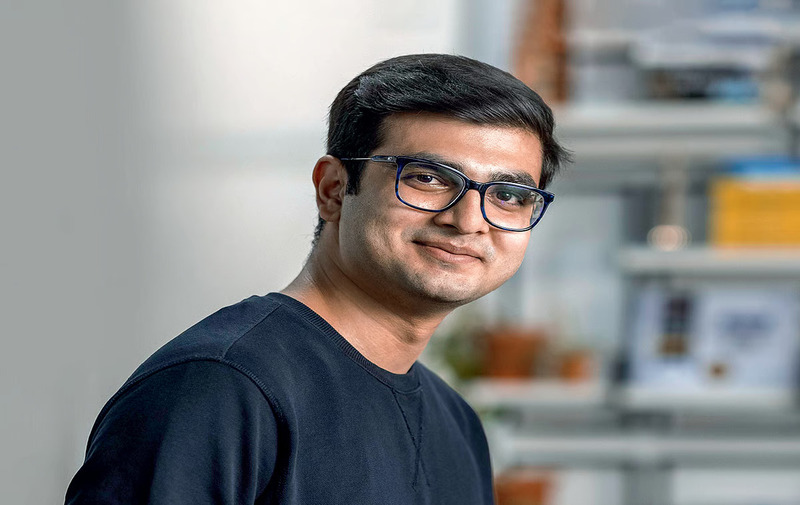
He Didn't Have the Internet Growing Up. Now His Satellites Are Changing the World
Long before artificial intelligence, smartphones and high-speed internet transformed classrooms, learning often depended on a handful of books and an endless supply of curiosity.For Awais Ahmed, growing up in the quiet village of Aldur in Karnataka's Chikkamagaluru district, space wasn't something he explored through YouTube videos or online courses. There was no internet at home for much of his childhood. Instead, there were encyclopedias his father lovingly brought home—filled with galaxies, planets and mysteries of the universe. Those books became his telescope to the cosmos.Years later, that same curious child would go on to build one of India's most celebrated private space companies, with satellites now orbiting Earth and helping solve some of the planet's biggest environmental challenges.When Curiosity Became a MissionInternet access reached Awais's village only when he was in Class 8. By then, his fascination with space had already taken root. Determined to pursue that passion, he enrolled at BITS Pilani, studying Mathematics while immersing himself in cutting-edge engineering projects.He joined Team Anant, the institute's student satellite programme developed in collaboration with ISRO, gaining firsthand experience in satellite design and space technology. His ambitions expanded even further when he became the engineering lead of Hyperloop India, one of the finalist teams in the prestigious SpaceX Hyperloop Pod Competition. Rather than spending another year completing a dual degree, Awais made a bold decision. He chose entrepreneurship over convention, believing he could help redefine how satellites observe Earth.A Missing Piece Sparked a Billion-Dollar IdeaThe breakthrough came unexpectedly in 2018. According to a report in The Times of India, Awais and his BITS Pilani batchmate Kshitij Khandelwal were participating in the IBM Watson AI Challenge. Their project relied on satellite imagery detailed enough to predict crop health. But they hit a wall.Existing satellites simply couldn't provide the quality of data they needed. Conventional Earth observation satellites capture images in only a limited number of broad spectral bands, making it difficult to identify early signs of crop disease, methane leaks, illegal mining or industrial pollution before visible damage appears. Instead of accepting the limitation, the two students decided to solve the problem themselves. Armed with little more than determination, borrowed money from Awais's father and a monthly budget of around ₹10,000, they founded Pixxel in February 2019 while still in their early twenties. What looked like an ambitious college dream soon became one of India's biggest private space success stories.Seeing What Ordinary Satellites CannotToday, Pixxel stands at the forefront of hyperspectral Earth observation. In 2025, the company successfully deployed all six of its Firefly satellites into orbit.Unlike traditional satellites, Pixxel's constellation captures Earth in more than 250 spectral bands at an impressive five-metre resolution, generating nearly 50 times more spectral information than conventional imaging systems. This extraordinary level of detail allows scientists, governments and industries to detect problems long before they become visible.Its satellites can identify crop stress weeks before farmers notice symptoms, detect methane leaks from oil and gas infrastructure, monitor illegal mining activities, assess industrial pollution and track contaminants flowing into rivers and lakes. In an era increasingly defined by climate change, food security and environmental sustainability, such insights have become invaluable.From Karnataka to Global RecognitionPixxel's rapid rise has earned admiration across the world. The company has raised approximately $95 million from leading global investors, including Google, Radical Ventures and Lightspeed, making it the world's highest-funded hyperspectral imaging startup.TIME named Pixxel among its 100 Best Inventions of 2023, while the World Economic Forum recognised it as a Technology Pioneer in 2024. The company also made history by becoming the first Indian space startup to secure a contract with NASA, followed by a five-year agreement with the US National Reconnaissance Office.Meanwhile, Awais himself has featured in prestigious lists including Forbes 30 Under 30, MIT Innovators Under 35 and Fortune India's 40 Under 40.Today, the satellites his company builds are helping humanity better understand and protect Earth itself. For countless students in small towns and villages, his story sends a powerful message: technology may accelerate learning, but curiosity is where every great journey truly begins.