
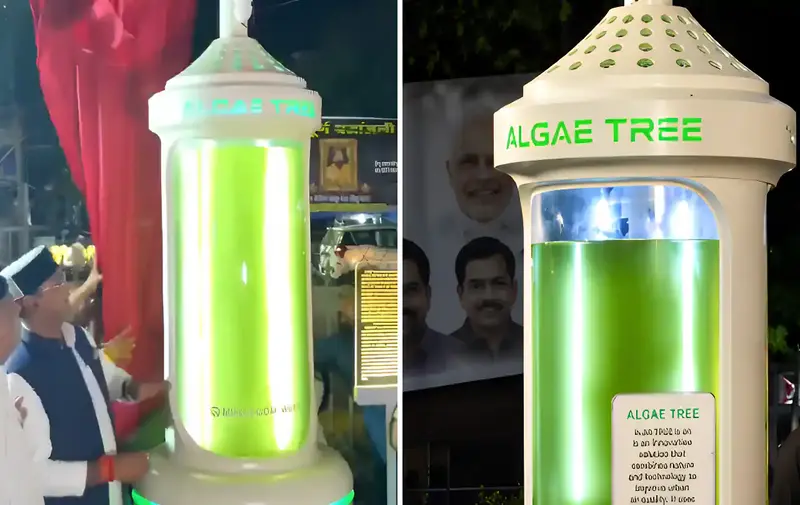
India’s First ‘Algae Tree’ Installed in Bhopal, Offers Oxygen Power of 25 Trees
In a remarkable step toward cleaner and greener cities, Bhopal has become home to India’s first-ever “Algae Tree”, an innovative carbon-capturing technology designed to tackle rising urban pollution. Installed at Swami Vivekananda Park under the Smart City initiative, the futuristic structure is already attracting nationwide attention for its potential to reshape urban sustainability.The revolutionary installation was inaugurated on May 1, 2026, by Cabinet Minister Vishwas Sarang and has quickly become a talking point across social media, with many calling it a glimpse into the future of environmental conservation.A Tree Unlike Any OtherDespite its name, the “Algae Tree” is not a traditional tree. Developed by Mushroom World Group, the device is a smart, solar-powered air purification system that uses microalgae to absorb carbon dioxide and release oxygen into the atmosphere.The project reportedly took nearly two years of research and involved a team of more than 50 engineers, researchers, and environmental specialists. Their goal was to create a sustainable solution for crowded urban areas where planting large numbers of trees is often impossible.The result is a compact structure capable of delivering environmental benefits that rival an entire cluster of mature trees.As Powerful as 25 TreesAccording to developers, a single Algae Tree unit can absorb around 1.5 tons of carbon dioxide annually while producing nearly 1 ton of oxygen. Even more impressively, its air-cleaning capability is said to match the impact of 25 fully grown trees.The technology also targets one of the most dangerous urban pollutants—PM2.5 particles. These microscopic pollutants, commonly generated by traffic, construction dust, and industrial activity, are linked to respiratory illnesses and poor air quality.Officials claim the Algae Tree can reduce PM2.5 levels by nearly 45 to 55 percent within a 15-meter radius, making it especially useful for roadsides, public parks, intersections, and densely populated spaces.Powered entirely by solar energy, the system offers an eco-friendly and energy-efficient model for pollution control.A Smart Solution for Urban IndiaIndian cities are increasingly facing a triple challenge: rising temperatures, worsening pollution, and shrinking green cover. While tree plantation drives remain important, many urban spaces simply lack enough room for large-scale planting.That is where the Algae Tree stands out. Rather than replacing natural trees, the technology has been designed to complement them. Experts involved in the project describe it as a support system for urban ecosystems, particularly in areas where concrete structures dominate the landscape.As heatwaves intensify and pollution levels continue to rise across major Indian cities, solutions like this could become part of future urban planning strategies.Social Media Reacts to the Futuristic InnovationPhotos and videos of the installation have spread rapidly online, with users praising the initiative as a bold and futuristic response to climate challenges.Many called it a “tree from the future,” while others highlighted how Indian cities urgently need innovative environmental technologies to deal with deteriorating air quality.Environmental enthusiasts have also welcomed the project for promoting scientific innovation while keeping sustainability at the centre of development.The installation of India’s first Algae Tree marks more than just a technological milestone, it reflects a growing shift toward smarter, science-driven climate solutions. If successful on a larger scale, similar units could soon appear in metro cities, busy traffic corridors, industrial zones, and public spaces across the country.