"Dream, Dream, Dream! Conduct these dreams into thoughts, and then transform them into action."
- Dr. A. P. J. Abdul Kalam
"Dream, Dream, Dream! Conduct these dreams into thoughts, and then transform them into action."
- Dr. A. P. J. Abdul Kalam
23 May 2026
India’s journey from launching modest satellites to scripting history on the Moon has reached yet another proud milestone.
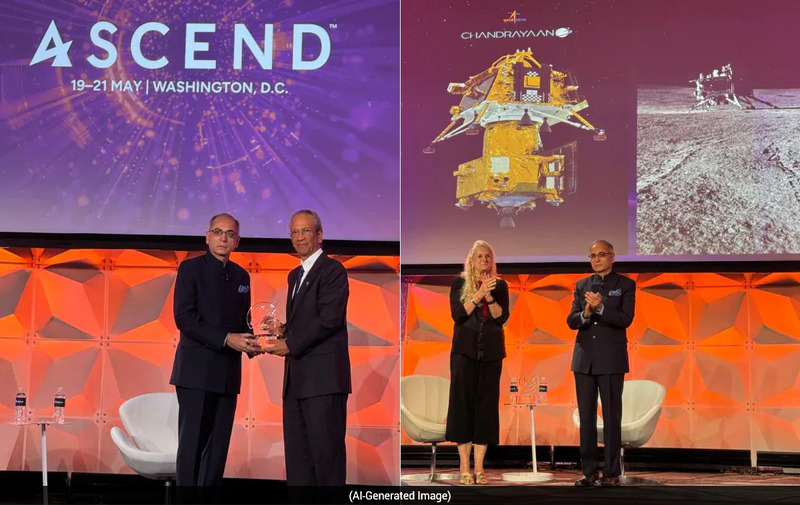
The Indian lunar mission, Indian Space Research Organisation’s Chandrayaan-3, has been honoured with the prestigious 2026 Goddard Astronautics Award by the American Institute of Aeronautics and Astronautics (AIAA).
The award was presented in Washington DC on May 21 during the AIAA ASCEND 2026 Conference, placing India among the world’s most respected spacefaring nations. The honour recognises Chandrayaan-3’s extraordinary contribution to astronautics and its historic success in exploring one of the Moon’s most challenging regions.
On August 23, 2023, Chandrayaan-3 created history by becoming the first spacecraft ever to achieve a soft landing near the Moon’s south pole. The achievement stunned the global scientific community because the lunar south pole had remained largely unexplored at the surface level due to its harsh terrain and extreme conditions.
With this mission, India became the fourth country in the world to successfully land on the Moon, joining an elite club of space powers. But Chandrayaan-3 went a step further by reaching a region that many nations had attempted to study but never successfully explored on the surface.
The Vikram lander and Pragyan rover carried out critical scientific experiments that provided valuable insights into the Moon’s composition, temperature, and surface conditions. Scientists also confirmed the presence of key chemical elements in the lunar soil, strengthening hopes that the Moon may one day support long-term human missions and even manufacturing activities.
The mission’s success was celebrated across the globe as a symbol of innovation, precision engineering, and cost-effective space exploration.
India’s Ambassador to the United States, Vinay Kwatra, accepted the award on behalf of ISRO during the ceremony.
In his address, Kwatra highlighted India’s growing ambitions in space exploration and outlined Prime Minister Narendra Modi’s ambitious Space Vision 2047 roadmap.
The vision includes deep space missions, expanded human spaceflight programmes, and the rapid growth of India’s commercial space ecosystem. He also stressed the importance of stronger collaboration between India and the United States in science, technology, and space exploration.
The Goddard Astronautics Award is regarded as the highest honour presented by AIAA for exceptional achievements in astronautics. It commemorates legendary rocket pioneer Robert H. Goddard, whose groundbreaking experiments with liquid rocket engines laid the foundation for modern space exploration.
The award recognises individuals or teams whose work significantly advances the field of astronautics. Over the decades, it has honoured some of the world’s most influential scientists, engineers, and space missions.
For Chandrayaan-3 to receive this recognition is not just a win for ISRO but a moment of immense pride for every Indian who watched the Moon landing with excitement and emotion.
Chandrayaan-3’s success and international recognition have strengthened India’s position as a rising leader in global space exploration. The mission demonstrated that innovation, determination, and scientific excellence can achieve extraordinary milestones even with comparatively lower budgets.
As India prepares for future lunar missions, the Gaganyaan human spaceflight programme, and deeper interplanetary exploration, the Goddard Astronautics Award serves as a reminder that the country’s space dreams are now inspiring the world.
.jpeg)
I have a Masters in Literature and a knack for spotting the silver lining! When I’m not chasing good news, you’ll find me nurturing my farm or lost in a good book.