"Dream, Dream, Dream! Conduct these dreams into thoughts, and then transform them into action."
- Dr. A. P. J. Abdul Kalam
"Dream, Dream, Dream! Conduct these dreams into thoughts, and then transform them into action."
- Dr. A. P. J. Abdul Kalam
21 Apr 2026
High above us, beyond the clouds and the blue sky, lies a region that is no longer empty. Thousands of satellites orbit Earth every day, helping us navigate, communicate, watch weather patterns, and even stream videos on our phones. But alongside these useful machines, there is also a growing cloud of space debris: old rocket parts, broken satellites, and fragments from past collisions. In this increasingly crowded environment, the need to track and monitor objects in space has never been more urgent. Recognizing this challenge, the Indian Space Research Organisation has taken a major step forward by strengthening its space tracking capabilities, ensuring that India remains prepared in this new and complex era of space activity.
At the heart of India’s current tracking system lies the Multi-Object Tracking Radar (MOTR), located at the Satish Dhawan Space Centre. This advanced system is not just a radar; it is a silent guardian of the skies. MOTR is an L-band active phased array radar designed to track multiple objects simultaneously. Using radio waves, it detects objects as small as those with a radar cross-section of 0.25 square meters from distances of up to 1,000 kilometers. Unlike the human eye, it does not depend on light. It works day and night, scanning the sky continuously, identifying satellites, rocket bodies, and debris. This technology plays a crucial role in understanding what is happening in Low Earth Orbit, the region roughly 500 to 1,000 kilometers above Earth, where most satellites operate.
Low Earth Orbit has become the busiest highway in space. With the rapid increase in satellite launches by countries and private companies, this region is now densely populated. While satellites serve vital purposes, the growing number of objects increases the risk of accidental collisions. Even a small piece of debris, traveling at thousands of kilometers per hour, can cause catastrophic damage. A single collision can create thousands of new fragments, triggering a chain reaction that threatens future missions. This is where the concept of Space Situational Awareness becomes critical. It involves tracking, monitoring, and predicting the movement of all objects in space. By knowing where everything is, space agencies can take preventive actions, such as adjusting satellite paths to avoid collisions.
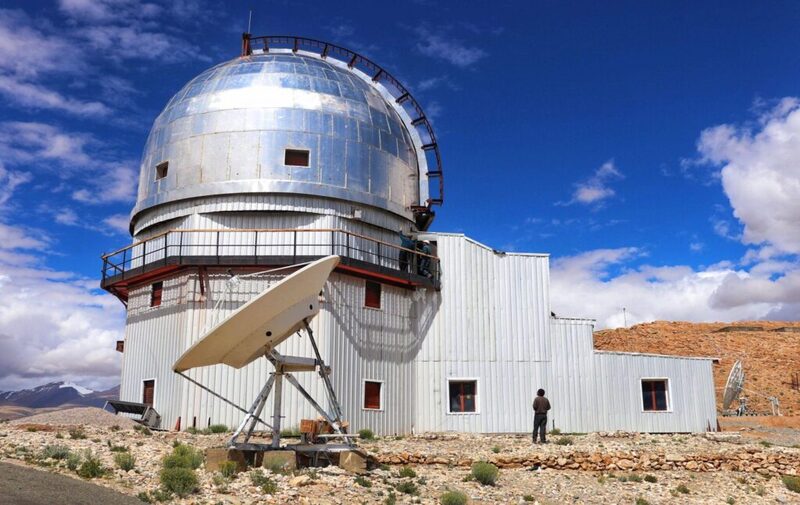
While MOTR provides powerful tracking capabilities, one radar alone is not enough. Just like a person on the ground can only see an aircraft for a few moments as it passes overhead, a single tracking station can only observe space objects when they are within its range. To overcome this limitation, ISRO is working on building a network of tracking facilities across the country. One of the most exciting developments is the installation of an optical telescope in Hanle, Ladakh. Situated in a high-altitude cold desert with clear, dark skies, Hanle offers ideal conditions for observing space objects at night. In addition, efforts are underway to establish an indigenously developed radar system in the northeastern region of India. This will expand coverage and improve the ability to track objects across different parts of the sky.
Tracking space objects is not a one-size-fits-all task. Radars and optical telescopes each have their strengths and limitations. Radars can operate at all times, regardless of lighting conditions, but they may have limitations in detecting very small or distant objects. Optical telescopes, on the other hand, rely on sunlight reflected from satellites and can only operate during nighttime under clear skies. By combining these technologies, ISRO is building a more comprehensive and reliable system. This integrated approach ensures better accuracy, wider coverage, and improved prediction capabilities. Together, these systems form the backbone of India’s Space Situational Awareness efforts, helping protect valuable space assets and ensuring sustainable operations.
As humanity looks beyond Earth toward deeper space exploration, the importance of managing our immediate cosmic neighborhood becomes even more critical. The steps taken today to monitor and protect Low Earth Orbit will shape the future of space missions. With initiatives like MOTR and the expansion of tracking facilities, the Indian Space Research Organisation is positioning itself as a key player in global space safety. This is not just about technology it is about vision. A vision where space remains safe, sustainable, and accessible for future generations. And as we look up at the night sky, filled with both stars and satellites, it is reassuring to know that somewhere, quietly and constantly, systems on Earth are watching over them, ensuring that the journey beyond our planet continues safely.

Romanticizing life and shaping stories from everything I see through my journalistic lens. Also, I love sports on the side.