"Dream, Dream, Dream! Conduct these dreams into thoughts, and then transform them into action."
- Dr. A. P. J. Abdul Kalam
"Dream, Dream, Dream! Conduct these dreams into thoughts, and then transform them into action."
- Dr. A. P. J. Abdul Kalam
19 Dec 2025
Beneath oceans, rivers, ports and docks lies a world that is both vital and dangerous. Inspection of ship hulls, seabeds, pipelines and underwater structures is essential for national security, infrastructure safety and marine monitoring. Yet, this work pushes human divers to physical limits, exposing them to extreme pressure, low visibility and serious risk. This is the challenge that Coratia Technologies, a deep-tech startup from Rourkela, Odisha, set out to solve by replacing risky human intervention with intelligent, made-in-India underwater robots.
The story of Coratia Technologies begins at the National Institute of Technology (NIT), Rourkela. Debendra Pradhan and Biswajit Swain met as Mechanical Engineering students, bonded by a shared curiosity for robotics and problem-solving. During their college years, they formed a student team and began building underwater robots from scratch. What started as a learning exercise soon became a serious pursuit. Participating in national and global robotics competitions exposed them to real-world challenges and market gaps. One issue stood out clearly: India depended heavily on imported underwater robotic systems that were expensive and difficult to maintain.
After graduating in 2017, both founders took corporate jobs in India and abroad. The jobs offered stability, but the dream of building something meaningful never faded. They knew that underwater robotics had both commercial and strategic importance for India. In 2021, they made a decisive move. Leaving their corporate careers behind, Debendra and Biswajit committed full-time to their vision and formally built Coratia Technologies, incubated at NIT Rourkela. It was a risky decision, but one driven by purpose rather than comfort.
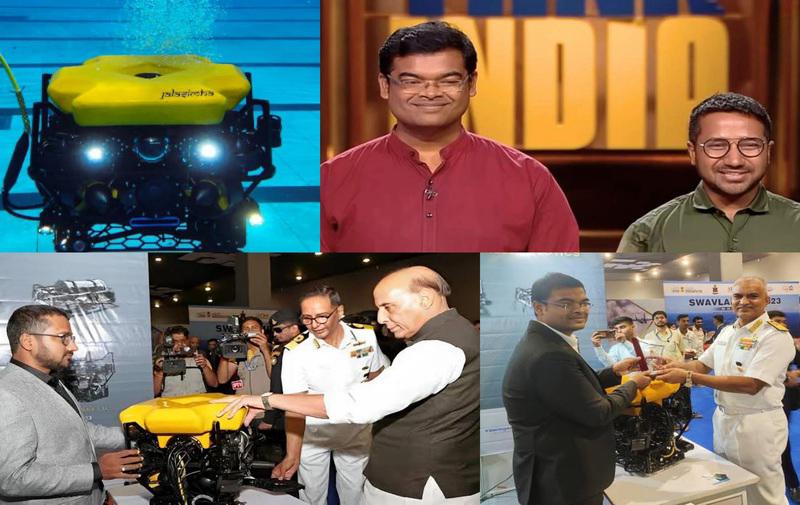
Coratia’s first major product, Jaladuta, marked their entry into the commercial market. Designed as an underwater remotely operated vehicle, Jaladuta is used for inspecting bridges, dams, pipelines, ports and ship hulls. Equipped with high-resolution cameras, sonar systems, lights and a robotic arm, Jaladuta can collect critical data without sending divers underwater. It is sold as a product and also deployed by Coratia as an inspection service. This early success proved two things: Indian startups could build reliable underwater robots, and there was strong demand across public and private sectors from infrastructure agencies to offshore energy companies.
While civilian applications provided momentum, defence remained the founders' long-term goal. That breakthrough came through the Innovation for Defence Excellence (iDEX) program. Under iDEX, Coratia developed Jalsimha, an advanced underwater remotely operated vehicle tailored for naval requirements. Jalsimha supports ship hull inspection, seabed assessment and underwater watch duties. Tested in both open seas and inland waters, it integrates AI and machine learning, sonar mapping and frugal engineering to deliver high performance at significantly lower cost than imported alternatives.
Winning the iDEX challenge opened doors that once seemed distant. It directly led to a landmark 66 crore INR contract with the Indian Navy, marking Coratia’s entry into India’s defence supply ecosystem.
For India, the importance of indigenous underwater systems goes beyond cost. Imported platforms often come with restrictions, delayed upgrades and dependence on foreign vendors. Coratia’s success demonstrates that mission-critical underwater technologies can be designed, built and maintained within the country. The underwater robotics market itself is expanding rapidly, valued at USD 5.08 billion in 2025 and projected to reach USD 9.53 billion by 2030. Coratia’s UWROVs are already being used for dam and bridge inspections, ocean floor mapping, marine ecosystem monitoring, and inspection of offshore energy assets, pipelines and subsea cables.
Coratia Technologies gained national attention after appearing on Shark Tank India Season 3 in 2024. The exposure helped the startup raise around 5 crore INR in subsequent funding and further strengthened confidence in its technology. In another major milestone, the Indian Navy later signed a larger contract valued at 766 crore INR for Jalsimha systems, reinforcing trust in Coratia’s capabilities Today, when an Indian Navy vessel uses an indigenous underwater robot instead of relying on imported technology, that quiet success carries the imprint of their persistence. From a campus workshop at NIT Rourkela to the depths of India’s waters, Coratia Technologies stands as a reminder that big national capabilities often begin with small student experiments.

Writing about what truly matters, good news and stories to remind the world - it is brighter than we think.