"Dream, Dream, Dream! Conduct these dreams into thoughts, and then transform them into action."
- Dr. A. P. J. Abdul Kalam
"Dream, Dream, Dream! Conduct these dreams into thoughts, and then transform them into action."
- Dr. A. P. J. Abdul Kalam
21 Mar 2026
Rising quietly from the rugged terrain of Bundelkhand, Kalinjar Hill is not just a hill—it is a witness to billions of years of Earth’s history and centuries of human civilisation. Recently, this extraordinary region received national recognition as a Geo-Heritage Site by the Geological Survey of India, marking a proud moment for India’s natural and cultural heritage. This recognition is more than a title. It is an invitation—to explore, to understand, and to reconnect with the deep past that shapes our present.
At the heart of Kalinjar’s significance lies a rare and fascinating geological feature known as the Eparchaean Unconformity. While the term may sound complex, its meaning is truly awe-inspiring. It refers to a visible meeting point between rock layers formed in vastly different geological eras. At Kalinjar, nearly 2.5-billion-year-old Bundelkhand granite lies beneath 1.2-billion-year-old Kaimur sandstone. This natural “time gap” represents millions of years of Earth’s missing history, offering scientists a unique window into the planet’s ancient transformations. In simple words, Kalinjar is like an open book where each rock layer tells a story older than humanity itself.
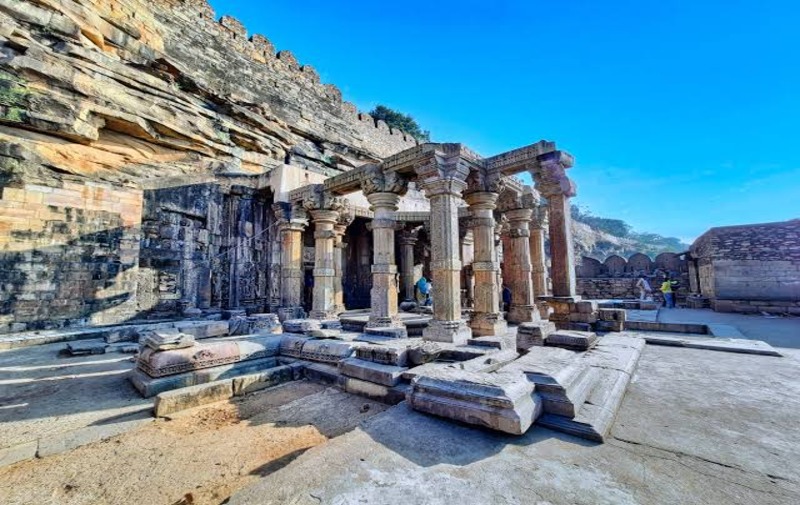
The importance of Kalinjar is not limited to science. Its geological structure played a crucial role in shaping history. The massive rocky terrain provided natural defence, making it an ideal location for building the formidable Kalinjar Fort. The elevation offered strategic advantage, while locally available stones were used to construct its strong walls. This unique relationship between land and architecture highlights a powerful geo-cultural connection where nature directly influenced human decisions, from settlement to warfare. Kalinjar was not just built on rock; it was protected by it.
Beyond its geological brilliance, Kalinjar Fort carries immense historical and spiritual significance. The fort has witnessed the rise and fall of several dynasties, including the Chedis, Mauryas, and Guptas. It even finds mention in ancient Buddhist literature, linking it to the era of Gautama Buddha. One of its most revered landmarks is the Neelkanth Mahadev Temple. According to mythology, this sacred site is associated with the legend of Lord Shiva consuming poison during the Samudra Manthan, earning the name “Neelkanth.” For pilgrims and visitors alike, Kalinjar is not just a destination it is an experience of faith, history, and timeless devotion.
The declaration of Kalinjar as a Geo-Heritage Site is expected to open new doors for tourism and conservation. Authorities are planning to include it in a broader heritage circuit connecting Khajuraho Group of Monuments and Chitrakoot—two culturally significant destinations. This integrated approach will not only attract tourists but also boost local livelihoods. The Geological Survey of India has already installed informational signage to help visitors understand the site’s geological and historical importance. Such efforts ensure that tourism does not come at the cost of preservation, but instead supports it.
What makes Kalinjar truly special is the way it connects different layers of existence. Here, geology meets history. Science meets spirituality. Nature meets human creativity. Imagine standing on a rock that formed billions of years ago, looking at a fort built centuries ago, and visiting a temple that still holds faith alive today. Few places in the world offer such a profound sense of continuity. It reminds us that we are part of a much larger story—one that began long before us and will continue long after.
The recognition of Kalinjar Hill as a Geo-Heritage Site is a reminder of the importance of protecting our natural and cultural treasures. In a rapidly changing world, such sites anchor us to our roots. They help us understand not just where we are, but where we come from. Because sometimes, the greatest stories are not written in books they are carved in stone. And Kalinjar is one of them.
Romanticizing life and shaping stories from everything I see through my journalistic lens. Also, I love sports on the side.