"Dream, Dream, Dream! Conduct these dreams into thoughts, and then transform them into action."
- Dr. A. P. J. Abdul Kalam
"Dream, Dream, Dream! Conduct these dreams into thoughts, and then transform them into action."
- Dr. A. P. J. Abdul Kalam
3 Mar 2026
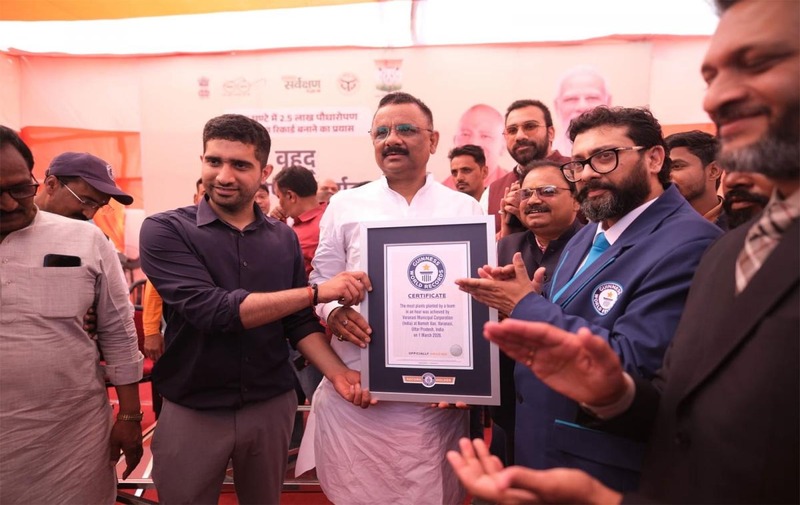
In an extraordinary display of speed, scale and civic spirit, the Varanasi Municipal Corporation (VMC) planted more than 2.5 lakh saplings in less than 60 minutes, creating what officials say is a new Guinness World Record.
The previous record of 1.53 lakh saplings in one hour, held by China, has now been surpassed. More than 20,000 citizens joined hands in this mega plantation drive on Sunday, transforming a patch of land near the ghats into a rapidly emerging green zone.
Municipal Commissioner Himanshu Nagpal called it a “historic initiative” and confirmed that the feat has been recognised by the Guinness Book of World Records.
But this wasn’t just about breaking a record. It was about building a legacy. The plantation is part of a larger plan to create an expansive urban forest park named ‘Namo Van’, located in the Domari area near the Ganga riverbank. Spread across 350 bighas of land, the project is being developed in the parliamentary constituency of Prime Minister Narendra Modi.
Officials say a total of 3 lakh saplings will be planted under the project. Of these, 2.5 lakh—planted during the record-breaking hour—follow the Miyawaki method, a Japanese technique known for creating dense, fast-growing native forests.
In addition, the site will include:
10,000 timber trees
40,000 fruit-bearing trees
A 4 km walking pathway
A meditation and yoga plaza
A 4-hectare flower park
A 2-hectare herbal park
A children’s play zone and gymnasium
What began as a plantation drive is now shaping up to be a multifunctional ecological and recreational hub.
Officials say the urban forest will do more than beautify the landscape. It is expected to:
Strengthen the Ganga riverbank
Enhance biodiversity
Improve ecological balance
Reduce urban heat
With rapid urbanisation putting pressure on green spaces, the initiative is being seen as a powerful environmental intervention. The dense Miyawaki plantation model ensures faster canopy formation, improved carbon absorption and better soil health.
Importantly, authorities have also made provisions for irrigation and plant survival, addressing one of the biggest challenges of large-scale plantation drives—long-term maintenance.
Interestingly, the project is also projected to generate economic returns.
According to officials, the Municipal Corporation expects to earn approximately ₹2 crore annually from the urban forest, a figure that could rise to ₹7 crore by the seventh year. If realised, this would demonstrate how ecological restoration and economic sustainability can go hand in hand.
Perhaps the most striking aspect of the event was public participation. More than 20,000 residents turned up to plant saplings in coordinated teams. Students, civic workers, volunteers and local organisations worked side by side. In one hour, a city rewrote a global record.
In the years ahead, the true success of this initiative will not only be measured in numbers but also in survival rates, shade cover, and the lives touched by this green transformation.
For now, Varanasi has shown that when civic ambition meets collective action, even a single hour can change the environmental narrative of a city.
.jpeg)
I have a Masters in Literature and a knack for spotting the silver lining! When I’m not chasing good news, you’ll find me nurturing my farm or lost in a good book.