"Dream, Dream, Dream! Conduct these dreams into thoughts, and then transform them into action."
- Dr. A. P. J. Abdul Kalam
"Dream, Dream, Dream! Conduct these dreams into thoughts, and then transform them into action."
- Dr. A. P. J. Abdul Kalam
12 Apr 2026
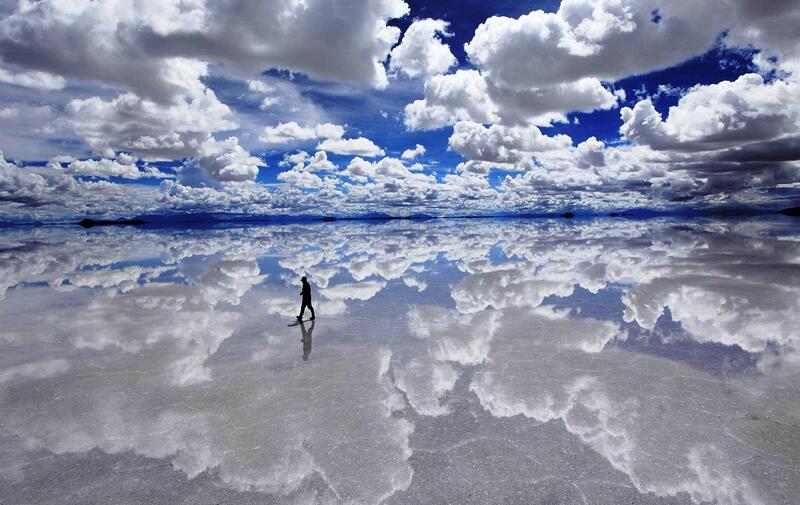
There are places in the world that you visit, and then there are places that stay with you forever. Hidden high in the Andes of Bolivia lies one such wonder, Salar de Uyuni, the largest salt flat on Earth. Stretching endlessly across more than 10,000 square kilometers, it is a land of extremes, beauty, and breathtaking illusion. But what truly makes this place magical is not just its size; it is its transformation. During certain months, this vast white desert becomes the world’s largest natural mirror, reflecting the sky so perfectly that the horizon disappears. It feels as if you are no longer standing on Earth but floating somewhere between heaven and reality.
The story of Salar de Uyuni begins thousands of years ago, when prehistoric lakes once covered this region. As those lakes gradually dried up, they left behind thick layers of salt, forming a crust that now stretches for miles. Today, this salt crust holds over 10 billion tons of salt, creating a surface so flat that the variation in elevation across the entire area is just a few meters. This natural precision is what makes the mirror effect possible, turning the land into a perfect reflective canvas when water covers it. It is not just geology; it is time itself, frozen into a landscape.
Between January and March, when rainwater lightly blankets the surface, something extraordinary happens. A thin sheet of water settles over the salt, creating a flawless reflection of the sky above. Clouds, sunlight, and even stars appear beneath your feet. The line between sky and land dissolves, leaving you in a surreal space where direction loses meaning. Photographers call it “walking on the sky,” but no photograph can fully capture what it feels like to stand there. Every step becomes a moment of wonder. Every glance feels unreal.
What makes Salar de Uyuni even more fascinating is how dramatically it changes with the seasons. In the dry months, from May to November, the landscape transforms into a vast white desert. The salt hardens into geometric patterns, stretching endlessly under a deep blue sky. It is stark, silent, and powerful. In contrast, the wet season brings softness and reflection. The same land that once looked harsh now becomes poetic, almost dreamlike. Two completely different worlds, both equally unforgettable.
While the endless white expanse is the main attraction, the region around Salar de Uyuni offers unique experiences that add depth to the journey. In the middle of the flats lies Incahuasi Island, a rocky island covered with towering cacti that seem to defy the barren surroundings. Standing here, you can see the vastness of the salt flat from a different perspective. Nearby, the eerie Train Graveyard tells stories of Bolivia’s industrial past, with rusted locomotives resting silently in the desert. There is also the famous salt hotel, built entirely from salt blocks, reminding visitors that even the simplest materials can create something extraordinary.
Beneath the stunning surface of Salar de Uyuni lies something of immense global importance—lithium. The region is believed to hold over 70% of the world’s lithium reserves, a key component in batteries that power everything from smartphones to electric vehicles. This makes the salt flat not just a natural wonder but also a critical resource for the future of technology and sustainability. It is a place where nature and modern life intersect in unexpected ways. Imagine standing there at sunrise, as the sky turns shades of orange and pink, perfectly mirrored beneath your feet. Imagine walking with no clear horizon, where every direction looks the same, yet feels different. In a world that often feels fast and crowded, this place offers something rare—stillness. It reminds you how vast the planet is and how small, yet connected, we are within it.
Travelers often say they come for the photos but leave with something deeper, a sense of awe that stays long after the journey ends.
Reaching Salar de Uyuni usually begins from the small town of Uyuni, where guided tours take visitors across this extraordinary landscape. The journey may be remote, the altitude challenging, and the temperatures cold, but every moment is worth it. Because this is not just a place you visit. It is a place you experience. In the end, Salar de Uyuni is more than the world’s largest salt flat. It is a reminder that nature still holds the power to surprise us, to inspire us, and to make us feel something beyond words. It is where the sky comes down to meet the earth. Where reality feels like a dream. And once you see it, you will understand why some journeys are not just about reaching a destination but about discovering a different way of seeing the world.

Romanticizing life and shaping stories from everything I see through my journalistic lens. Also, I love sports on the side.