"Dream, Dream, Dream! Conduct these dreams into thoughts, and then transform them into action."
- Dr. A. P. J. Abdul Kalam
"Dream, Dream, Dream! Conduct these dreams into thoughts, and then transform them into action."
- Dr. A. P. J. Abdul Kalam
7 Apr 2026
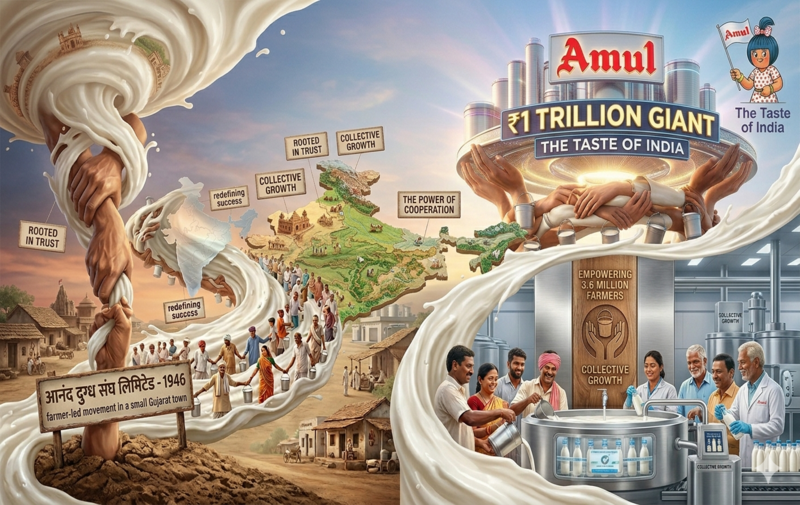
Long before it became a household name, Amul was an idea born out of struggle. In 1946, in the small town of Anand in Gujarat, local dairy farmers were tired of exploitation by middlemen who dictated prices and profits. Led by Tribhuvandas Patel and inspired by Sardar Vallabhbhai Patel, they decided to take control of their own destiny. What followed was not just the birth of a cooperative but the beginning of a movement. Soon, a young engineer named Verghese Kurien joined the mission. With vision and determination, he transformed this small initiative into a national phenomenon, sparking India’s White Revolution and turning the country into one of the world’s largest milk producers. From that moment, Amul was never just a brand. It became a symbol of empowerment.
Over the decades, Amul became deeply woven into the fabric of Indian life. From the morning cup of chai to school lunchboxes filled with buttered bread, from festive sweets to everyday essentials, Amul became a part of every Indian household. Its iconic advertising, especially the witty and ever-relevant “Amul Girl,” kept the brand alive in public memory, while its products reached even the smallest corners of the country. But behind every packet of milk or slice of cheese was something more powerful: millions of farmers working together. Today, Amul represents over 3.6 million dairy producers, making it one of the largest cooperative movements in the world.
Now, in 2026, Amul has achieved something truly remarkable. It has become India’s first FMCG company to cross the ₹1 trillion turnover mark. This milestone is not just about numbers; it is about scale, trust, and consistency. Under the leadership of CEO Jayen Mehta, the brand has recorded strong growth of around 11%, driven by both domestic demand and global expansion.
From small villages to international markets, Amul’s journey has reached new heights. One of the biggest reasons behind this achievement is Amul’s deep connection with India’s grassroots. The company expanded aggressively into smaller towns with populations above 5,000, ensuring that quality dairy products reached even the most remote areas. At the same time, it adapted to changing consumer preferences, introducing products focused on health and wellness, including protein-rich, probiotic, and organic offerings. Value-added products like cheese, buttermilk, and yogurt saw strong demand, proving that Amul continues to evolve with the times while staying true to its roots.
Amul’s story is no longer confined to India. Today, it operates in over 50 countries, with a growing presence in regions like the United States and Europe. Its global expansion reflects not just business growth but also the rising demand for Indian dairy expertise. With plans to enter 10 more international markets, Amul is steadily transforming into a global dairy powerhouse. And yet, at its core, it remains a farmer-owned cooperative.
Unlike many large corporations, it is owned by farmers. Its three-tier cooperative model from village societies to district unions to state-level federation ensures that profits and benefits flow back to the producers. This model has stood the test of time. Leaders like Ashok Chaudhary and Gordhan Dhameliya have emphasized that this milestone is not just a corporate success; it is a reflection of the trust of millions of consumers and the hard work of millions of farmers. In a world dominated by corporate giants, Amul proves that collective strength can be just as powerful.
For most Indians, Amul is not just a company; it is a memory. It is the butter spread on warm rotis at home. It is the taste of childhood. It is the familiarity of something that has always been there. And for farmers, it is dignity. It is financial stability. It is the assurance that their hard work will be valued. Every litre of milk collected, every product sold, carries a human story behind it.
As Amul crosses the ₹1 trillion milestone, it also looks ahead. The focus is not just on growth but on innovation, developing sustainable products, expanding globally, and ensuring that farmers continue to benefit from technological advancements. It is a reminder that success is not just about reaching the top but about bringing others along with you. From a small cooperative in Anand to a global dairy leader, it reflects the power of vision, resilience, and unity. This ₹1 trillion milestone is not just is a national moment of pride.

Writing about what truly matters, good news and stories to remind the world - it is brighter than we think.