"Dream, Dream, Dream! Conduct these dreams into thoughts, and then transform them into action."
- Dr. A. P. J. Abdul Kalam
"Dream, Dream, Dream! Conduct these dreams into thoughts, and then transform them into action."
- Dr. A. P. J. Abdul Kalam
12 Mar 2026
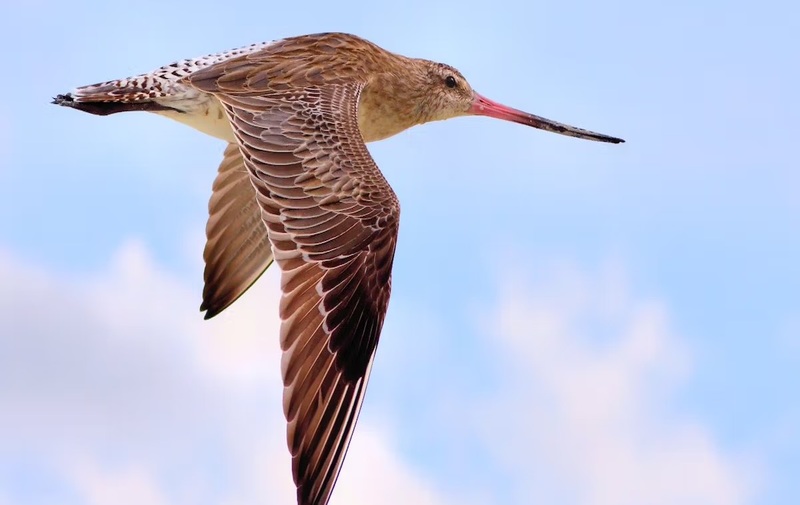
Nature continues to surprise us with extraordinary feats of endurance and survival. In October 2022, a juvenile Bar-tailed Godwit achieved something remarkable completing the longest non-stop bird flight ever recorded. The young bird, tagged “234684,” flew approximately 13,560 kilometres (8,425 miles) from Alaska in the United States to Tasmania in Australia. What makes this journey even more astonishing is that the bird completed the entire trip without stopping for food, water, or rest, remaining in the air for 11 days and one hour. This incredible migration highlights the remarkable abilities of migratory birds and offers scientists deeper insights into how animals adapt to some of the most demanding journeys on Earth.
The bird belongs to the species Bar-tailed Godwit (Limosa lapponica baueri), a long-distance migratory shorebird known for its impressive endurance. Every year, these birds migrate between their breeding grounds in Alaska and wintering habitats in Australia and New Zealand. However, the journey undertaken by bird 234684 broke all previous records for uninterrupted flight. The bird’s path took it across the vast Pacific Ocean, one of the largest stretches of open water on the planet. Starting in Alaska, the bird flew southward until it reached Ansons Bay in Tasmania, where it finally landed after more than eleven continuous days in the air. The flight was tracked using a 5G satellite tag, which allowed scientists to follow the bird’s exact route and confirm the incredible distance traveled.
The idea of flying continuously for over a week may seem impossible, but the Bar-tailed Godwit has evolved unique adaptations that allow it to accomplish such journeys. Before migration, these birds undergo an intense preparation phase. They dramatically increase their body weight by storing large amounts of fat, sometimes nearly doubling their weight. This fat serves as the bird’s primary fuel during the journey. Fat is highly energy-rich, allowing the bird to sustain flight for days without eating. Another fascinating adaptation is the bird’s ability to temporarily shrink certain internal organs, particularly those related to digestion. Since the bird will not be eating during the migration, reducing the size of these organs helps conserve energy and make more room for fat reserves. These biological adjustments make the bird lighter and more efficient in the air, enabling it to cover massive distances without stopping.
Migration is one of the most fascinating phenomena in the natural world. Many birds travel thousands of kilometres every year in search of better breeding conditions, warmer climates, or abundant food sources. For the Bar-tailed Godwit, Alaska provides ideal summer breeding grounds, with long daylight hours and abundant insects for feeding chicks. However, as winter approaches and temperatures drop, the birds migrate south to warmer regions such as Australia and New Zealand. Scientists believe these birds rely on a combination of environmental cues, internal biological clocks, the Earth’s magnetic field, and even the position of the sun and stars to navigate their journeys. The ability of bird 234684 to travel across oceans without losing direction demonstrates how finely tuned these navigation systems are.
The historic journey of bird 234684 was made possible by modern tracking technology. Researchers attached a small satellite transmitter to the bird before it began its migration. The device sends location signals to satellites, allowing scientists to track the bird’s movements in real time. This technology has revolutionized the study of bird migration. In the past, researchers could only guess migration routes based on sightings and banding records. Today, satellite tags provide detailed information about flight paths, speed, altitude, and stopover locations. Such data helps scientists better understand how migratory birds respond to environmental changes, including climate change and habitat loss.
The journey of the Bar-tailed Godwit is not just a scientific marvel; it is also a reminder of how delicate migratory ecosystems can be. Migratory birds depend on multiple habitats across continents to survive. If even one crucial stopover or breeding ground is destroyed, it can disrupt the entire migration cycle. Wetlands, coastal areas, and mudflats where these birds feed and rest are increasingly threatened by urban development, pollution, and climate change. Protecting these ecosystems is essential not only for birds like the Bar-tailed Godwit but also for maintaining biodiversity across the planet. As scientists continue to study such journeys, each discovery deepens our appreciation for the natural world—and reminds us of the responsibility we share in protecting it. Sometimes, the greatest stories of courage and endurance come not from humans, but from a small bird flying silently across the vast sky.

Romanticizing life and shaping stories from everything I see through my journalistic lens. Also, I love sports on the side.