"Dream, Dream, Dream! Conduct these dreams into thoughts, and then transform them into action."
- Dr. A. P. J. Abdul Kalam
"Dream, Dream, Dream! Conduct these dreams into thoughts, and then transform them into action."
- Dr. A. P. J. Abdul Kalam
23 Feb 2026
In the snow-covered stretches of Bandipora and other high-altitude regions of Jammu & Kashmir, winter does more than freeze rivers and roads—it freezes classrooms. According to the UDISE+ 2024–25 report, the general secondary school dropout rate in the Union Territory stands at 12.9 percent. For Scheduled Tribe (ST) students, that number climbs sharply to 17.7 percent, and for Scheduled Caste (SC) students, it rises to 15.7 percent. These figures are not just statistics. They represent thousands of young dreams interrupted, ambitions delayed, and futures uncertain. The gap highlights a persistent inequality in educational continuity for marginalized communities in the region. While poverty, mobility, and socio-economic pressures contribute to these numbers, one factor remains largely invisible yet deeply impactful the winter learning blackout.
In many remote and mountainous areas of the Kashmir Valley, winter is not merely a season; it is a period of isolation. Heavy snowfall blocks roads, electricity becomes unreliable, and temperatures drop drastically. Schools remain closed for nearly three months. For students in urban settings, such breaks might be filled with private tutoring, internet access, and family support systems. But for children in remote tribal villages, especially first-generation learners, winter often means a complete halt to academic engagement. There are no structured study sessions, limited access to books, and almost no digital connectivity. This prolonged academic pause creates what educators call a “learning slide.” Concepts learned in the previous term begin to fade. Confidence declines. When schools reopen in spring, students often feel overwhelmed, struggling to catch up with new lessons built on foundations they no longer fully remember. Over time, this repeated cycle widens learning gaps and pushes vulnerable students closer to dropping out.
The secondary level is a critical stage in a student’s academic journey. It is the bridge between foundational learning and higher education or skill-based careers. The higher dropout rate among ST and SC students at this stage signals deeper systemic challenges. For tribal families who depend on seasonal labor or migrate for work, education competes with economic survival. If a student returns after winter and finds it difficult to cope with coursework, the temptation to leave school and contribute to household income becomes stronger. Each winter break thus acts like a silent barrier, adding cumulative gaps year after year. By the time students reach higher classes, the academic mountain feels too steep to climb. The dropout is rarely sudden; it is often the final step in a slow process of disengagement.

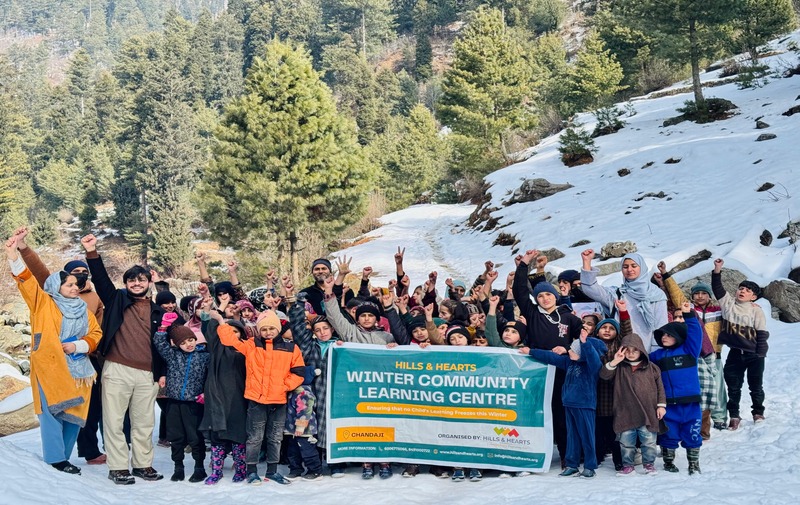
Amid this challenge, a grassroots initiative is offering a powerful counter-narrative. The Hills and Hearts Foundation has established three Winter Community Learning Centres in the remote areas of Chandagi, Ketson, and Reshwari. These centres are designed to operate during the peak winter months, precisely when formal schooling pauses. They provide a structured academic environment for more than 400 children from tribal and labor-class families. Instead of allowing the season to dictate their learning, students now have a warm, consistent space to continue their education. Kifayatullah Malik, Founder of the Hills and Hearts Foundation and a National Presidential Awardee, emphasizes the urgency behind the initiative. He notes that when a child loses three months of academic momentum every year, the cumulative effect becomes a major factor in eventual dropout. The centres act as a bridge, ensuring that education does not “freeze with the terrain.”
One of the most remarkable aspects of the initiative is its community-driven model. The centres are staffed by local youth volunteers who understand the terrain, the language, and the lived realities of the children. This approach does more than provide academic support. It builds trust. When children see older students from their own villages guiding them, education becomes relatable and attainable. The volunteers become role models, showing that persistence through harsh conditions can lead to opportunity. Beyond core subjects, the centres also provide extracurricular engagement. Storytelling sessions, group discussions, creative activities, and peer learning circles help maintain curiosity and social interaction during months that would otherwise be marked by isolation. Education here is not reduced to textbooks alone; it becomes a space of emotional and intellectual continuity.
The initiative by Hills and Hearts reflects a broader principle: geography and weather should not dictate educational outcomes. Seasonal isolation is a structural issue, but it does not have to be a permanent barrier. Community-led interventions, especially those that operate during academic breaks, can significantly reduce learning loss. When supported by policy backing, infrastructure development, and digital inclusion efforts, such models can be replicated across other remote regions of India facing similar climatic challenges. The dropout gap among ST and SC students is a reminder that equality in education is not achieved merely by opening schools. It requires sustained access, continuity, and context-sensitive solutions. As Jammu & Kashmir confronts its dropout challenge, the lesson is clear: when communities step forward to bridge gaps, even the coldest winters cannot extinguish the warmth of learning.
From Snowbound Villages to Global Classrooms: A Winter Lesson in Educational Equity
The winter learning initiative in Jammu & Kashmir offers a powerful model for the rest of India and the world. It proves that educational gaps caused by climate, geography, or poverty can be addressed through community-driven solutions. Instead of waiting for systemic change, local youth stepped forward to protect children’s academic continuity. States facing floods, heatwaves, or migration-related disruptions can adopt similar seasonal learning centres to prevent dropout. Globally, regions with extreme weather from mountain communities to conflict zones—can learn that resilience in education begins at the grassroots. When communities own the solution, learning never has to pause.
Romanticizing life and shaping stories from everything I see through my journalistic lens. Also, I love sports on the side.