"Dream, Dream, Dream! Conduct these dreams into thoughts, and then transform them into action."
- Dr. A. P. J. Abdul Kalam
"Dream, Dream, Dream! Conduct these dreams into thoughts, and then transform them into action."
- Dr. A. P. J. Abdul Kalam
17 Feb 2026
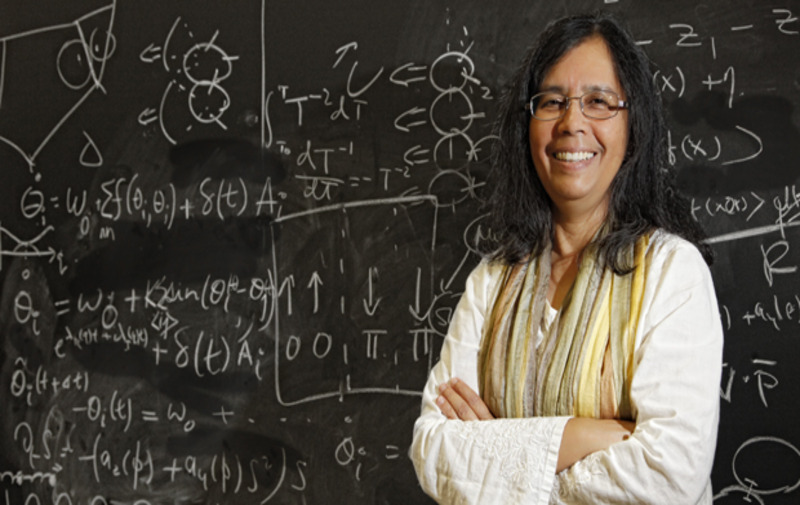
In a city that celebrates reinvention, Bulbul Chakraborty’s story still feels extraordinary. At 71, the Indian American, condensed matter physicist, long known for her work on granular materials and jamming systems, won one of New York theatre’s most respected honors, the Obie Award, for her very first acting performance. The award recognised her role in the off-Broadway play Rheology, praising the honesty and emotional force she brought to the stage. For decades, Chakraborty’s world revolved around equations, research papers and university lecture halls. Theatre was not part of the plan. Yet in 2025, she found herself standing under stage lights in Brooklyn, performing before strangers—not as a fictional character, but as herself.
Rheology is a one-act play written and directed by her son, Shayok Misha Chowdhury. The work blends science, personal memory and performance into a tightly structured exploration of mortality. On stage, Chowdhury imagines a future in which his mother has died. He confronts his fear that he might not survive her absence. Chakraborty, appearing as herself within the scripted framework, challenges that belief. Their exchanges move between tenderness and tension, grief and quiet humour. The play avoids sentimentality. Instead, it holds its emotional ground with restraint and clarity.
The title refers to the study of how materials flow and deform, a field central to Chakraborty’s scientific career. Granular materials such as sand can behave like a solid in one moment and collapse the next. This scientific idea becomes the play’s central metaphor. Human relationships, like sand, can feel stable until they suddenly shift under pressure. Grief, too, reshapes the emotional landscape without warning. The science remains accessible. The metaphors are simple yet resonant, allowing audiences without a technical background to grasp the emotional stakes.
Chakraborty does not deliver a lecture on stage. Although the performance begins with a short, self-contained explanation of physics, what follows is theatre in its purest sense. She speaks, sings, listens and inhabits silence within the dramatic structure of the play. Her lack of formal acting training becomes part of the work’s power. There is no theatrical polish masking vulnerability. The audience does not see a professor explaining ideas. They witness a woman confronting her own mortality, performing within a scripted framework that demands emotional precision. Silence and stillness become active elements. The pauses are as significant as the words. In this space, science turns into emotional language.
The origins of Rheology were deeply personal. What began as a project to help her son confront his fear of losing his mother gradually became something Chakraborty herself had to face. Each performance required her to think about her own death—not abstractly, but in front of an audience. The emotional labour was real. Performing grief publicly blurs the boundary between art and life. Yet that vulnerability is precisely what resonated with audiences. After shows at The Bushwick Starr in Brooklyn, viewers often approached her to speak about their own families. Younger audience members said they felt compelled to call their mothers. The play did not offer easy comfort or neat resolutions. Instead, it created space for reflection and connection. In a culture that often avoids direct conversations about mortality, Rheology invited them openly, without melodrama.
The New York theatre community responded with attention and admiration. Reviews in The New York Times and The New Yorker highlighted the play’s unusual structure and emotional clarity. Critics noted the rare shift from theoretical physics to the stage, recognising the courage it required. The Obie Award, announced in early 2026, confirmed that response. The citation praised Chakraborty’s openness and the emotional force of her performance. In a competitive theatre landscape filled with trained performers, her recognition stood out. The honour placed her among New York’s most compelling new performers of the season—a remarkable distinction for someone who had never previously acted.
Long before she stepped onto a stage, Chakraborty had established herself as a respected scientist. She earned her doctorate from the State University of New York at Stony Brook in 1979 and joined the faculty at Brandeis University in 1989. As a condensed matter physicist, she focused on granular matter, jamming transitions and systems far from equilibrium. Her work contributed to understanding how disordered materials behave, with research with implications across engineering and materials science. She became a fellow of the American Physical Society in 2008 and received a Simons Fellowship in 2018. Her academic career was defined by intellectual rigour. The stage, by contrast, required emotional exposure. Yet both disciplines share a core similarity: a search for underlying truth.
Perhaps the most striking aspect of this story is its timing. At 71, many professionals are content to rest on established reputations. Chakraborty chose to risk public vulnerability in a field entirely new to her. Her decision began as a family collaboration. It became an artistic milestone. The Obie Award symbolises more than theatrical achievement. It reflects the courage to step beyond familiar identities. On a small Brooklyn stage, a physicist found another language for life’s most universal truths. In doing so, she reminded audiences that reinvention is always possible and that the boundaries between science and art, like sand under pressure, are more fluid than they seem.

Romanticizing life and shaping stories from everything I see through my journalistic lens. Also, I love sports on the side.