"Dream, Dream, Dream! Conduct these dreams into thoughts, and then transform them into action."
- Dr. A. P. J. Abdul Kalam
"Dream, Dream, Dream! Conduct these dreams into thoughts, and then transform them into action."
- Dr. A. P. J. Abdul Kalam
16 Feb 2026
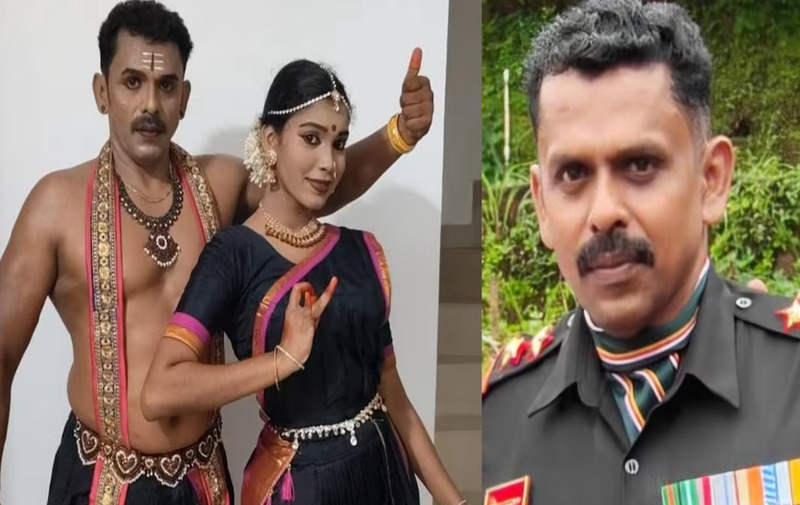
For 28 years, he stood guard at India’s borders, facing harsh weather, uncertainty, and the constant weight of responsibility. Today, he stands barefoot on a temple stage in Kerala, eyes focused, hands poised in mudra, learning rhythm and expression from someone half his height—his 17-year-old daughter. Honorary Subedar Major Lijesh T P, a retired Indian Army officer, has traded camouflage for costume, rifle drills for adavus, and battlefield discipline for the structured grace of Bharatanatyam. What makes his story remarkable is not just the shift in profession, but the teacher guiding him, his daughter, Vaidehi.
At the annual festival of the Thrikkapalam Dakshinamoorthy Shiva Temple in Kannur, the audience noticed Lijesh seated in the front rows, watching attentively as his daughter prepared to perform. Many assumed he was there as a supportive father, beaming with pride. But when the announcement was made and he walked onto the stage beside Vaidehi, surprise rippled through the crowd. Dressed in traditional attire, he took his place not as a chief guest or dignitary, but as a fellow performer, her student. The four-minute piece they presented depicted the mythological Samudra Manthan, the cosmic churning of the ocean, a story rich in symbolism, power, and rhythm. When the final pose froze and the music ended, the applause was loud and heartfelt. It was not just appreciation for technique but for courage and humility.
After retiring from the Indian Army in 2024, Lijesh found himself adjusting to civilian life. Like many veterans, the shift from regimented service to a slower pace can feel disorienting. Yet instead of retreating into routine, he chose reinvention. At home, he had watched Vaidehi practise Bharatanatyam for years. The discipline, repetition, and expressive storytelling fascinated him. One day, what began as a playful challenge, "Can you try this step, Acha?” turned into something deeper. He started learning. Daily practice sessions became part of their routine. Vaidehi corrected his posture, guided his hand gestures, and counted beats aloud. The house echoed with rhythmic syllables and laughter. The former soldier, accustomed to commanding troops, now listened carefully to instructions from his teenage daughter. It was a role reversal that strengthened their bond.
Bharatanatyam is not merely dance; it is a classical art form rooted in centuries-old tradition. Originating in Tamil Nadu and codified in ancient texts like the Natya Shastra, it combines intricate footwork, precise hand gestures, expressive facial movements, and devotional storytelling. For someone trained in the discipline of the Army, the structured nature of Bharatanatyam offered familiarity. The early morning drills of military life were replaced by repetitive adavus. The focus once needed in combat found a new expression in abhinaya, the art of conveying emotion. When asked whether performing on stage made him nervous, Lijesh responded with a perspective shaped by experience. Compared to 28 years in the Army, he said, this was not frightening. Having witnessed war, loss, and intense situations, stage fright held no power over him.
Their chosen performance, Samudra Manthan, tells of gods and demons churning the ocean to obtain amrita, the nectar of immortality. It is a story of struggle, cooperation, endurance, and eventual reward. In many ways, it mirrored Lijesh’s own journey. The years of service, the physical and emotional challenges, and the transition to a new phase of life all required churning through uncertainty to discover renewed purpose. On stage, father and daughter portrayed cosmic tension and harmony through synchronized movements. The symbolism was powerful: a retired soldier and a young artist, representing generations, working together to create something meaningful.
Now, the duo is preparing for their next performance. What started as a playful challenge has become a commitment to continue learning and performing together. Lijesh’s journey from the border to the Bharatanatyam stage reflects a universal truth: reinvention is possible at any stage of life. Retirement does not mean retreat. It can mean rediscovery. In a world that often boxes people into fixed identities—soldier, parent, child—this father-daughter pair reminds us that identities can expand. The applause at the temple festival was not merely for their technical skill. It was for courage, humility, and the beautiful reminder that learning never ends. From guarding borders to mastering mudras, Honorary Subedar Major Lijesh T P has embraced a new mission, one guided by rhythm, devotion, and the steady voice of his teenage daughter counting the beat.
Romanticizing life and shaping stories from everything I see through my journalistic lens. Also, I love sports on the side.