"Dream, Dream, Dream! Conduct these dreams into thoughts, and then transform them into action."
- Dr. A. P. J. Abdul Kalam
"Dream, Dream, Dream! Conduct these dreams into thoughts, and then transform them into action."
- Dr. A. P. J. Abdul Kalam
8 Apr 2026
We often say “I love you to the moon and back” as a metaphor, something poetic, something symbolic. But aboard Artemis II, that phrase took on a meaning far deeper than words. As four astronauts journeyed farther from Earth than any humans before them, breaking records and pushing scientific boundaries, they also carried something invisible yet powerful: memories, love, and loss. And in one unforgettable moment, floating in the silence of space, they turned that emotion into history.
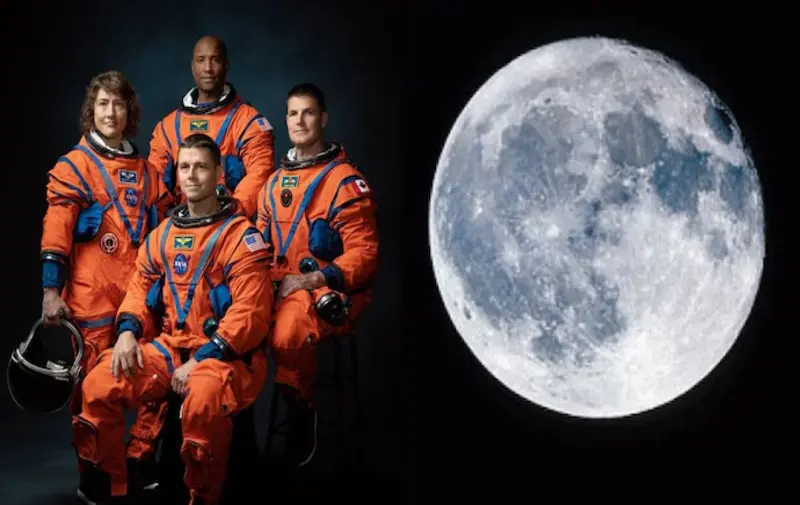
The Artemis II mission is not just another spaceflight. It marks humanity’s bold return toward the Moon, decades after the era of Apollo 13. Led by Reid Wiseman, alongside Victor Glover, Christina Koch, and Jeremy Hansen, the crew traveled an astonishing 252,000+ miles away from Earth—setting a new record in human spaceflight. Inside their spacecraft, named Integrity, they weren’t just explorers. They were witnesses to a view very few humans have ever seen: the vast, quiet expanse of space, with Earth slowly shrinking into the distance. Yet, even at that unimaginable distance, their thoughts remained deeply rooted back home.
During their lunar flyby, the crew made a heartfelt proposal. They wanted to name two craters on the Moon. One would be called Integrity, after their spacecraft. The other would carry a far more personal meaning. Jeremy Hansen spoke to mission control, his voice carrying both pride and emotion. He shared the story of Carroll, the late wife of Reid Wiseman, who passed away from cancer in 2020. “She was a mother, a caregiver, and someone who dedicated her life to helping others,” he said. Carroll Wiseman had been a neonatal intensive care nurse, someone who spent her life saving others at their most fragile moments. And now, her name was being carried to the Moon. The crew proposed naming a bright lunar crater “Carroll.” A permanent mark. A memory etched not just in hearts but in the universe itself.
What followed was something rarely seen in space missions. As Hansen finished the tribute, the astronauts floated toward each other and embraced. Inside the spacecraft, in zero gravity, they hugged. Christina Koch wiped away tears. Reid Wiseman, a commander, a father, a man who had endured loss, stood surrounded by his crew, his second family. In that moment, space was no longer distant or cold. It was deeply human. Because even millions of miles away from Earth, emotions remain weightless but never absent.
Space missions are often defined by numbers—distance, speed, technology. And Artemis II delivered all of that. The crew captured high-resolution images of the Moon, studied ancient craters like the Orientale Basin, and crossed into regions never seen by human eyes. They even experienced a communication blackout as the Moon blocked signals, a reminder of just how far they had ventured.
When Space Showed Us a View We Had Never Seen Before
During the historic Artemis II, astronauts witnessed a breathtaking sight never seen before. From their position near the Moon, they observed a rare solar eclipse where the Moon completely blocked the Sun for nearly 54 minutes, far longer than eclipses seen from Earth. With the Sun hidden, its outer atmosphere, called the corona, appeared as a glowing halo around the Moon, revealing details usually invisible due to brightness. The darkness also allowed astronauts to see stars clearly in the background, something not possible during normal lunar observations. Adding to the beauty, the Moon wasn’t entirely dark. A faint glow lit its surface, caused by sunlight reflected from Earth, known as Earthshine. This unique view was not just stunning but scientifically valuable, helping researchers better understand the Sun and space environment as humanity continues its journey deeper into space.
For the first time, astronauts captured what can be described as an “Earth setting” moment, combined with a rare and powerful celestial event. From their unique position near the Moon, they watched as the Moon moved perfectly in front of the Sun, creating a breathtaking total eclipse but on a scale far beyond what we experience on Earth.

As Artemis II prepares to splash down back on Earth, its legacy is already secure. Not just as a mission that broke records. But as one that broke emotional barriers. Because in the vast silence of space, where words often feel small, one simple gesture spoke louder than anything else: That love doesn’t end. It travels. It endures. And sometimes, it even finds its place among the stars. Because when humanity reaches for the Moon, it doesn’t just carry technology; it carries stories, memories, and the people we never truly leave behind.

Writing about what truly matters, good news and stories to remind the world - it is brighter than we think.