"Dream, Dream, Dream! Conduct these dreams into thoughts, and then transform them into action."
- Dr. A. P. J. Abdul Kalam
"Dream, Dream, Dream! Conduct these dreams into thoughts, and then transform them into action."
- Dr. A. P. J. Abdul Kalam
23 Feb 2026
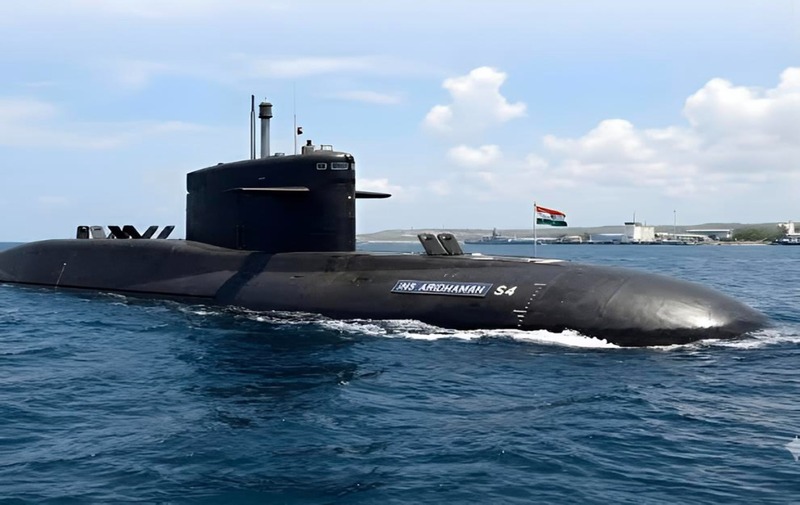
Deep under the waters of the Bay of Bengal, a silent guardian is preparing to join India’s strategic shield. As global tensions shift and maritime power becomes increasingly important, India is set to commission its third indigenously built nuclear-powered ballistic missile submarine, INS Aridhaman. This is not just another addition to the Navy’s fleet; it represents years of scientific dedication, strategic planning, and a quiet but firm assertion of India’s place among major maritime powers. Built under the Advanced Technology Vessel (ATV) project at the Ship Building Centre in Visakhapatnam, INS Aridhaman, designated S4, is expected to be commissioned by April-May after completing final sea trials. With its induction, India moves closer to achieving a long-held strategic goal: continuous at-sea deterrence.
INS Aridhaman is larger and more advanced than its predecessors, INS Arihant and INS Arighaat. While the earlier submarines displaced around 6,000 tonnes, Aridhaman weighs approximately 7,000 tonnes. This increase in size allows for greater endurance, enhanced stealth features, and expanded missile capacity. One of its major upgrades is the presence of eight vertical launch system (VLS) tubes, compared to four on the earlier submarines. This enables it to carry up to 24 K-15 Sagarika short-range submarine-launched ballistic missiles with a range of 750 km, or eight K-4 intermediate-range missiles capable of striking targets up to 3,500 km away. The submarine is also designed to eventually accommodate the longer-range K-5 missile, which is expected to have a range of around 6,000 km. Powered by an 83 MW Compact Light Water Reactor (CLWR), Aridhaman features an upgraded pressurised water reactor designed for a very low acoustic signature. This makes it harder for adversaries to detect. Its seven-blade propeller allows speeds of 12–15 knots on the surface and up to 24 knots underwater. Indigenous sonar systems such as USHUS and Panchendriya, along with anechoic tiles on its hull, further enhance stealth and detection capabilities. The submarine will operate from Project Varsha, a high-security naval base near Visakhapatnam with underground pens designed to protect strategic assets from surveillance and attack.
India’s nuclear doctrine is built around the concept of a credible minimum deterrent and a No First Use policy. The nuclear triad—land-based missiles, air-delivered weapons, and sea-based deterrents—forms the backbone of this strategy. The sea-based leg is considered the most survivable because submarines can remain hidden underwater for long durations. With the commissioning of INS Aridhaman, India will for the first time have three operational ballistic missile submarines under the Strategic Forces Command. This significantly strengthens the country’s ability to maintain at least one submarine on patrol at all times. This is crucial for achieving Continuous At-Sea Deterrence, a strategic policy that ensures a nation always has a nuclear-armed submarine deployed and ready. Countries like the United Kingdom and France have maintained such capabilities for decades. For India, this marks a historic milestone in its strategic journey.
Second-strike capability is one of the most important elements of nuclear deterrence. It ensures that even if a country suffers a nuclear attack, it retains the ability to respond with a retaliatory strike. This assurance discourages adversaries from launching a first strike in the first place. INS Aridhaman enhances this second-strike capability. Hidden deep underwater, beyond the reach of most surveillance systems, it acts as a silent guarantor of national security. In simple human terms, it is like a security system that cannot be easily disabled, ensuring that peace is preserved through strength. For the people of India, this submarine is not just a piece of military hardware. It is the result of decades of scientific research, engineering excellence, and national resolve. Thousands of scientists, engineers, and naval personnel have contributed to its development. Behind its steel hull lies the hard work of Indian minds striving for self-reliance.
The commissioning of INS Aridhaman also comes at a time of shifting regional dynamics. Pakistan is enhancing its underwater capabilities by acquiring eight Hangor-class diesel-electric submarines from China under a multi-billion-dollar agreement signed in 2015. These submarines are expected to significantly boost Pakistan’s naval strength in the Arabian Sea. At the same time, India is preparing to lease another Russian Akula-class nuclear-powered attack submarine, widely known as Chakra III, expected around 2027–28. Nuclear-powered attack submarines (SSNs) differ from ballistic missile submarines (SSBNs) in their role. While SSBNs carry strategic nuclear missiles, SSNs are designed for speed, stealth, and offensive operations, including tracking enemy submarines and protecting carrier groups. Additionally, India is negotiating with Germany for six advanced diesel-electric submarines under Project-75(1), further strengthening conventional underwater capabilities.
Few nations in the world possess this capability. For young Indians dreaming of becoming scientists, engineers, or naval officers, this submarine is proof that India can achieve world-class technological excellence. It reflects a nation that believes in building its own strength quietly and confidently. And in that silent mission, INS Aridhaman will play a defining role in safeguarding India’s future.

Romanticizing life and shaping stories from everything I see through my journalistic lens. Also, I love sports on the side.