"Dream, Dream, Dream! Conduct these dreams into thoughts, and then transform them into action."
- Dr. A. P. J. Abdul Kalam
"Dream, Dream, Dream! Conduct these dreams into thoughts, and then transform them into action."
- Dr. A. P. J. Abdul Kalam
24 Oct 2026
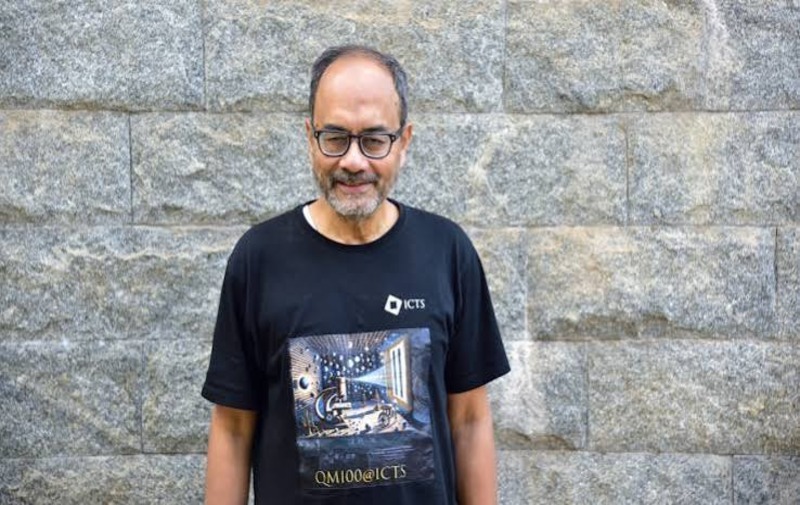
Indian physicist Ashoke Sen has added another remarkable achievement to his illustrious career by winning the prestigious Oskar Klein Medal, one of the major international honours in theoretical physics. The Bengaluru-based International Centre for Theoretical Sciences (ICTS), where Sen serves as a professor, announced the recognition.
Sen is the first Indian to receive the medal, which has been awarded annually since 1988 by Stockholm University and the Nobel Committee for Physics of the Royal Swedish Academy of Sciences. Named after Swedish theoretical physicist Oskar Klein, the award recognises distinguished contributions to physics. Its past recipients include renowned scientists Chen-Ning Yang, Steven Weinberg and Hans Bethe.
Sen is internationally celebrated for his pioneering research in string theory, a framework that seeks to reconcile quantum mechanics with gravity. Scientists explore this approach in their quest to understand the fundamental particles and forces that govern the universe, from the smallest subatomic scales to the vastness of space.
According to ICTS, Sen's influential work on S-duality, black hole entropy and string field theory has helped shape modern string theory. His research has also advanced understanding of the quantum properties of black holes, including how their entropy can be calculated with remarkable precision.
He pioneered the study of unstable D-branes and formulated the celebrated Sen conjecture on open string tachyon condensation. His work on rolling tachyons has also influenced research into string cosmology, while his contributions to superstring perturbation theory have opened further avenues for investigation.
As part of the honour, Sen delivered the 2026 Oskar Klein Memorial Lecture, titled Gravity from Strings and Strings from Gravity, at Stockholm University's AlbaNova Centre in October.
The Oskar Klein Medal joins an impressive list of recognitions earned by the physicist over several decades. Sen received the Shanti Swarup Bhatnagar Prize in 1994 and the Padma Shri in 2001. In 2009, he was awarded the Infosys Prize in Mathematical Sciences.
In 2012, he became one of the inaugural recipients of the Breakthrough Prize in Fundamental Physics for his contributions to the unifying structure of string theory. He received the Padma Bhushan in 2013 and the Dirac Medal in 2014. He is also a Fellow of the Royal Society and leading Indian science academies.
Born in Kolkata in 1956, Sen studied at Presidency College in Kolkata and IIT Kanpur before pursuing doctoral research at Stony Brook University in the United States.
His latest achievement celebrates not only an exceptional scientific career but also India's contribution to the pursuit of some of physics' biggest questions.
.jpeg)
I have a Masters in Literature and a knack for spotting the silver lining! When I’m not chasing good news, you’ll find me nurturing my farm or lost in a good book.