"Dream, Dream, Dream! Conduct these dreams into thoughts, and then transform them into action."
- Dr. A. P. J. Abdul Kalam
"Dream, Dream, Dream! Conduct these dreams into thoughts, and then transform them into action."
- Dr. A. P. J. Abdul Kalam
15 Sep 2026
What if the waste left behind by steel production could help build India’s roads?
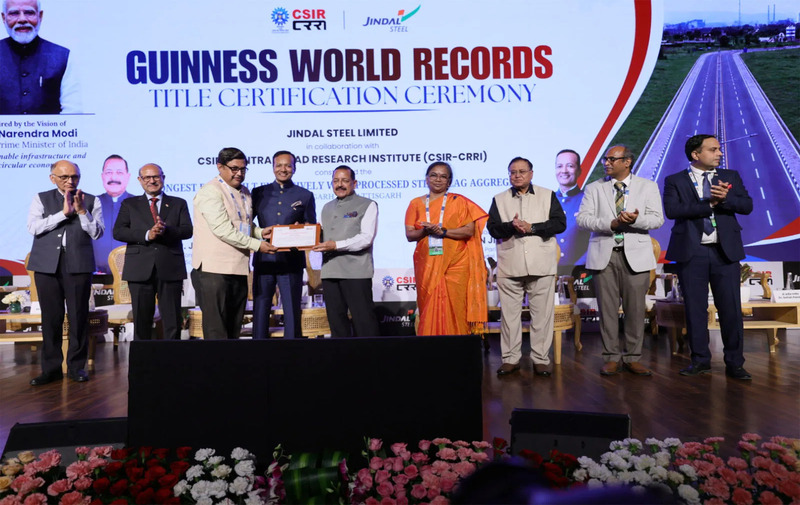
A project in Raigarh, Chhattisgarh, has shown exactly how this can work. Jindal Steel Limited, in collaboration with CSIR–Central Road Research Institute (CSIR-CRRI), has earned a Guinness World Records title for constructing the world’s longest road built exclusively with processed steel slag aggregates.
The 1.85-km, four-lane divided road is equivalent to 7.4 lane-km and has been designed to handle heavy commercial traffic. It uses around 200,000 tonnes of processed electric arc furnace (EAF) steel slag across its full pavement depth.
Steel slag is a non-metallic by-product generated during steel production. It forms when impurities in iron combine with materials such as lime and dolomite at extremely high temperatures. Instead of treating this material as waste, the project processes it into engineered road aggregates.
The slag undergoes controlled ageing and stabilisation, followed by metal recovery, crushing, screening, grading and detailed quality checks. It is then subjected to physical, mechanical, geotechnical and environmental testing before being used in road construction. The processed material has been used throughout the pavement, including the formation, granular and bituminous layers.
One of the biggest advantages of the project is that it achieved 100% replacement of natural aggregates with processed steel slag. This means approximately 200,000 tonnes of virgin stone could be saved, reducing dependence on quarrying and the extraction, processing and transportation associated with conventional road materials.
According ton a report in ANI News, the innovative pavement is also approximately 35% thinner, while the construction cost could be reduced by up to 40%. Designed for a loading of 65 million standard axle repetitions, the road demonstrates that processed steel slag can potentially serve demanding infrastructure needs.
The achievement also marks a push towards giving industrial by-products a second life. Jindal Steel has launched SteelGrit, its brand of processed steel slag aggregates, as an engineered construction material. The company and CSIR-CRRI have also signed a technology transfer agreement to support wider adoption of the technology beyond Raigarh.
The project offers a striking example of how industrial waste can become a useful resource—turning a challenge of waste management into an opportunity for more sustainable infrastructure.
.jpeg)
I have a Masters in Literature and a knack for spotting the silver lining! When I’m not chasing good news, you’ll find me nurturing my farm or lost in a good book.