"Dream, Dream, Dream! Conduct these dreams into thoughts, and then transform them into action."
- Dr. A. P. J. Abdul Kalam
"Dream, Dream, Dream! Conduct these dreams into thoughts, and then transform them into action."
- Dr. A. P. J. Abdul Kalam
23 Feb 2026
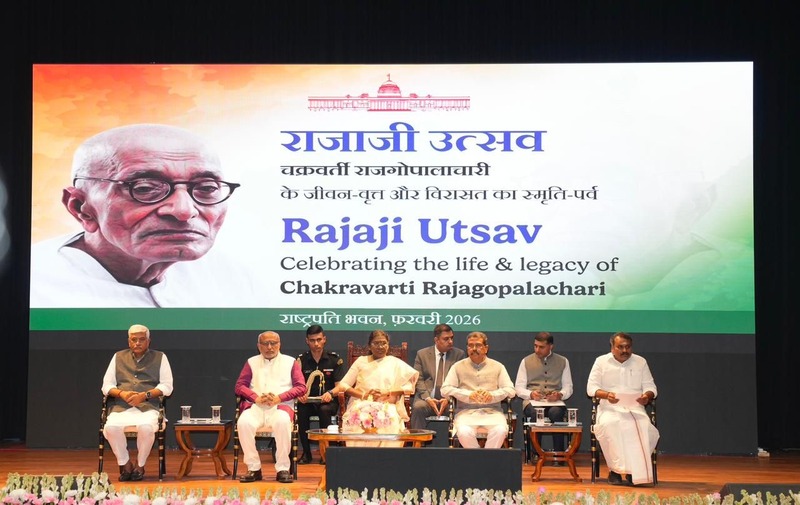
Today, February 23, 2026, Rashtrapati Bhavan becomes more than the residence of India’s President. It becomes a stage for history to correct itself. In a powerful symbolic gesture, the statue of British architect Edwin Lutyens is being replaced with that of C. Rajagopalachari, fondly known as Rajaji, the first Indian Governor-General of independent India. Announced by Prime Minister Narendra Modi during the 131st episode of Mann Ki Baat, Rajaji Utsav is not merely a ceremonial event. It is a declaration. A declaration that India is steadily moving away from colonial symbols and consciously reclaiming its own narrative. The unveiling of Rajaji’s statue in the central courtyard of Rashtrapati Bhavan represents more than a structural change. It represents a psychological and cultural shift.

In his address, Prime Minister Modi recalled the ‘Panch-Pran’ he spoke of during Azadi Ka Amrit Mahotsav. One of those vows was freedom from the mentality of slavery. Rajaji Utsav embodies that vow. For decades after independence, colonial-era statues continued to stand within one of the most powerful buildings in India. The presence of Edwin Lutyens’ statue symbolized architectural legacy, but it also reflected a lingering imprint of British rule. By replacing it with Rajaji’s statue, India sends a subtle yet powerful message: it is time to honor its own sons and daughters. This is not about erasing history. It is about rebalancing it.
Born on December 10, 1878, in the Madras Presidency, C. Rajagopalachari was far more than a statesman. He was a lawyer, thinker, writer, freedom fighter, and reformer. An early associate of Mahatma Gandhi, Rajaji gave up his legal career to join the freedom struggle. He participated in movements against the Rowlatt Act, supported the Non-Cooperation Movement, and played a significant role in Civil Disobedience campaigns. His political journey was marked not by ambition but by conviction. Rajaji later became a member of the Constituent Assembly from Madras and served on the sub-committee on minorities, contributing to the shaping of India’s democratic foundation. In 1954, he was awarded the Bharat Ratna, India’s highest civilian honor. Yet perhaps his most defining role came in 1948, when he became the first and only Indian Governor-General of independent India, serving until 1950. In that office, he demonstrated rare simplicity, moral discipline, and independent thinking.

Prime Minister Modi described Rajaji as someone who saw power not as a position but as service. That sentiment captures the essence of the man. Rajaji was known for his self-restraint and clarity of thought. He was unafraid to disagree when conscience demanded it. His political life was guided by principles rather than popularity. One of his notable contributions before Independence was the Temple Entry Authorization and Indemnity Act of 1939, which allowed Dalits and marginalized communities access to temples. In an era of deep social divides, Rajaji stood firmly for inclusion.
Rajaji Utsav is not confined to the unveiling of a statue. From February 23 to March 1, Rashtrapati Bhavan will host an exhibition dedicated to Rajagopalachari’s life and contributions. The exhibition aims to reconnect citizens, especially younger generations, with a leader who played a crucial role in shaping modern India but is often less discussed in mainstream narratives. In many ways, this week-long celebration bridges past and present. It encourages reflection on what freedom truly means—not just political independence, but mental decolonization.
For many Indians, Rashtrapati Bhavan symbolizes authority, governance, and national pride. Seeing Rajaji’s statue there transforms that symbolism into something more relatable. It reminds citizens that the nation’s highest offices were once occupied by individuals who walked among the people, who protested, who sacrificed careers, and who believed in service over status. In an age where leadership is often measured by visibility and power, Rajaji’s life offers a quieter lesson. Integrity outlasts authority. Values outlive titles. Today’s unveiling is therefore not only about honoring the past. It is about inspiring the present.
Rajaji Utsav aligns with a broader national effort to foreground Indian culture and heritage within public spaces. By consciously replacing colonial imagery with Indian icons, the state signals a renewed commitment to cultural confidence. Such gestures, while symbolic, have emotional resonance. They invite citizens to rethink whose stories are displayed in national institutions. They encourage young minds to discover leaders beyond textbook headlines. This is how nations mature. Not by denying their history, but by choosing which legacies to elevate.
As Rajaji’s statue stands tall in the central courtyard of Rashtrapati Bhavan, it represents more than a tribute to one man. It symbolizes India’s ongoing journey of self-definition. Rajaji Utsav reminds us that independence is not a static achievement. It is a continuous process of reclaiming voice, identity, and memory. On this February 23, 2026, history feels alive. Not in textbooks, but in bronze. Not in speeches alone, but in a space once dominated by colonial shadows. Today, Rashtrapati Bhavan does not just unveil a statue. It unveils a statement. And that statement says India remembers. India honors. India moves forward.

Writing about what truly matters, good news and stories to remind the world - it is brighter than we think.