"Dream, Dream, Dream! Conduct these dreams into thoughts, and then transform them into action."
- Dr. A. P. J. Abdul Kalam
"Dream, Dream, Dream! Conduct these dreams into thoughts, and then transform them into action."
- Dr. A. P. J. Abdul Kalam
7 Feb 2026
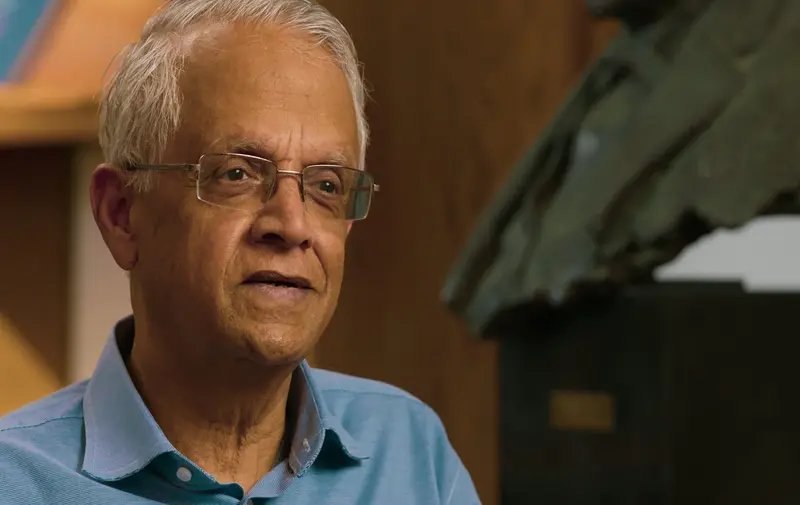
In 1975, deep inside NASA’s research corridors, a young Indian-origin scientist made a discovery that would alter humanity’s understanding of climate change long before global warming became a household phrase. Veerabhadran Ramanathan found that chlorofluorocarbons, or CFCs, commonly used in aerosols and refrigerators, could trap heat in the atmosphere up to 10,000 times more effectively than carbon dioxide. Five decades later, that moment has come full circle.
Ramanathan, now 82, has been awarded the 2026 Crafoord Prize in Geosciences by the Royal Swedish Academy of Sciences, an honour often described as the Nobel of Geosciences. The award recognises a lifetime of scientific breakthroughs that reshaped climate science and influenced global policy.
The Crafoord Prize is among the world’s most prestigious scientific honours, awarded in disciplines not covered by the Nobel Prizes. It carries a cash award of 8 million Swedish kronor (about $900,000) and a gold medal and will be presented during Crafoord Days in Stockholm and Lund in May 2026. For Ramanathan, the prize acknowledges decades of pioneering research on super-pollutants and atmospheric brown clouds, concepts that fundamentally changed how scientists measure and understand global warming.
His work revealed that climate change is not driven by carbon dioxide alone but also by short-lived pollutants that heat the planet rapidly and unevenly.
Ramanathan’s journey is as remarkable as his science. Born in Madurai and raised in Chennai, his early life was far removed from global conferences and international treaties. He began his professional career not in a laboratory, but as an engineer in a refrigerator factory in Secunderabad. Ironically, it was there that he first encountered CFCs, the very chemicals that would later define his scientific legacy. Those early years grounded him in practical realities. Rather than viewing climate science as abstract equations, Ramanathan approached it as a human problem—one that affects livelihoods, health, and survival. This perspective would later shape both his research and his global advocacy.
While carbon dioxide dominates climate conversations, Ramanathan’s work exposed the outsized role of super-pollutants such as CFCs, methane, and black carbon. These substances remain in the atmosphere for shorter periods than CO₂, but their heat-trapping ability is far more intense. His research demonstrated that reducing these pollutants could slow global warming significantly in the near term, buying the world precious time to transition to cleaner energy systems. This insight transformed climate strategy, shifting it from a single-gas focus to a multi-pollutant approach. Ramanathan’s Indian roots deeply influenced his scientific direction. Through the Indian Ocean Experiment (INDOEX), he identified vast atmospheric brown clouds hovering over South Asia layers of pollution made up of soot, sulphates, and other particles. The findings were alarming.
Few scientists can claim their work directly influenced international law. Ramanathan can. His early discoveries on CFCs helped lay the scientific foundation for the Montreal Protocol, one of the most successful environmental treaties in history. The agreement has prevented millions of tons of harmful emissions from entering the atmosphere and is widely credited with helping protect the ozone layer. Today, the Montreal Protocol stands as proof that science-backed global cooperation can work—a legacy inseparable from Ramanathan’s research.
Now a Distinguished Professor Emeritus at the Scripps Institution of Oceanography, University of California, San Diego, Ramanathan’s influence extends beyond academia. He has advised world leaders, international organisations, and even the Vatican, helping frame climate change not only as a scientific crisis but also as a moral and ethical one. He has consistently argued that climate change disproportionately affects the poor, making it a question of justice as much as science. This blend of rigorous research and human concern has set him apart in a field often dominated by data alone.
At 82, Ramanathan’s career is a reminder that transformative science is rarely loud or instant. It unfolds patiently, shaped by curiosity, persistence, and lived experience. From handling CFCs in a factory to uncovering their planetary consequences, his journey reflects the power of connecting everyday realities with global thinking. The Crafoord Prize does more than honour a scientist; it honours an idea that knowledge, when guided by responsibility, can change the world. As climate challenges grow more urgent, Veerabhadran Ramanathan’s life work stands as both a warning and a guidepost showing what happens when science dares to look deeper and when one human story reshapes the fate of the planet.
Romanticizing life and shaping stories from everything I see through my journalistic lens. Also, I love sports on the side.