"Dream, Dream, Dream! Conduct these dreams into thoughts, and then transform them into action."
- Dr. A. P. J. Abdul Kalam
"Dream, Dream, Dream! Conduct these dreams into thoughts, and then transform them into action."
- Dr. A. P. J. Abdul Kalam
17 Mar 2026
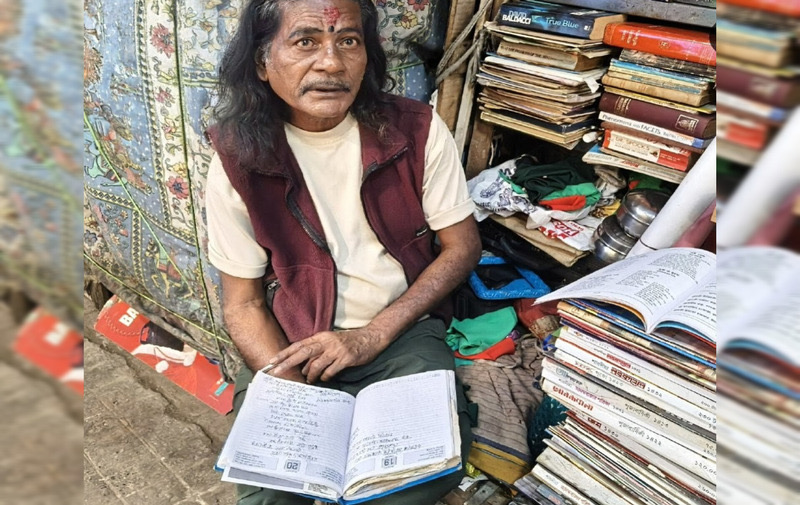
On a busy pavement in Kolkata, where life rushes past in honking traffic and hurried footsteps, sits a man who has chosen a different rhythm. Mohan Das is not just a bookseller he is a poet, a thinker, and a guardian of old-world reading habits. For over four decades, he has written one poem every single day, without fail. In a time where screens dominate attention and digital reading is the norm, Mohan Das continues to believe in the simple, soulful power of paper and pen.
Mohan Das’s journey began with hardship. At just 12 years old, he stepped into responsibility, selling paper bags to help support his family. Life did not offer him the luxury of a carefree childhood. Instead, it demanded resilience. As he grew older, his days became a careful balance between survival and dreams. He attended college during the day and worked at a public canteen in the evenings. But even in the middle of this struggle, he held on to something deeply personal his love for books. Books became his escape, his education, and his silent companions.
While many around him were focused on earning a living, Mohan Das was quietly building a world of imagination. He found himself drawn to literary giants like Leo Tolstoy, Charles Dickens, and Sarat Chandra Chattopadhyay. Their stories helped him understand life, emotions, and human struggles in ways his surroundings could not. Through their words, he discovered a deeper meaning of existence. For Mohan, literature was not just reading it was living many lives through pages.
In the late 1980s, his passion for books took a physical form. He set up a small pavement bookstall in Gariahat, one of Kolkata’s busiest and most vibrant areas. The stall was modest, but it carried something special a personal touch. Every book on display reflected his taste, his journey, and his belief in the power of storytelling. Customers didn’t just come to buy books. They came for conversations, recommendations, and sometimes, something even more unique his poetry. At the age of 31, Mohan Das wrote his first poem. It was inspired by his own life—his struggles, his thoughts, and the world he observed every day. What started as a single expression soon turned into a lifelong discipline. From that day on, he made a promise to himself to write one poem every day. And he kept that promise. For over 40 years, through good days and bad, through illness and exhaustion, through financial struggles and personal challenges, Mohan Das never missed a single day of writing. This consistency is not just rare it is extraordinary.
Today, Mohan Das’s bookstall is more than just a place to buy books. It is a small cultural corner in the heart of Kolkata. People often stop by out of curiosity but stay longer than expected. Some browse through books, while others engage in conversations about literature and life. And many leave with something unexpected a poem written by Mohan himself. His poetry is simple, honest, and deeply human. It reflects everyday struggles, quiet hopes, and the beauty hidden in ordinary moments. In a fast-paced world, his words offer a pause—a moment to reflect.
In an era dominated by smartphones and digital reading, Mohan Das holds a firm belief books should be read on paper. He often tells his customers not to lose themselves in PDFs and screens. For him, reading a physical book is an experience that cannot be replaced. The feel of pages, the smell of paper, and the connection it creates with the reader is something he deeply values. This philosophy is not about rejecting technology—it is about preserving a timeless habit that connects people to stories in a more meaningful way. Mohan Das once shared that his choices may have taken him away from a more comfortable life. But he does not regret them. “As long as books and poetry are on my side, I think I can carry on,” he said in an interview. These words reflect a rare kind of contentment. In a world chasing success, wealth, and recognition, Mohan has chosen passion, simplicity, and purpose. And in doing so, he has found something many people spend their lives searching for peace. In the crowded streets of Kolkata, his small bookstall stands as a reminder that stories still matter, poetry still lives, and dreams no matter how simple are always worth holding on to. And if you ever find yourself there, you might not just leave with a book you might leave with a piece of his heart, written in verse.

Writing about what truly matters, good news and stories to remind the world - it is brighter than we think.