"Dream, Dream, Dream! Conduct these dreams into thoughts, and then transform them into action."
- Dr. A. P. J. Abdul Kalam
"Dream, Dream, Dream! Conduct these dreams into thoughts, and then transform them into action."
- Dr. A. P. J. Abdul Kalam
10 Sep 2026
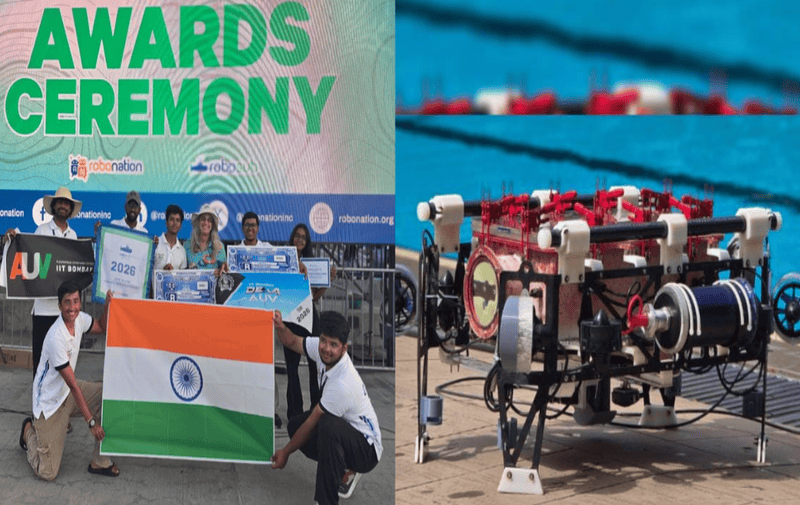
What happens when young engineers are challenged to build machines that can explore the underwater world on their own? At RoboSub 2026, students from IIT Bombay answered with an impressive display of technology, teamwork and precision.
The Autonomous Underwater Vehicle (AUV) team of Indian Institute of Technology Bombay secured first place in the Overall Wildcard Challenge and first place in the Overall Website Evaluation at the international competition held in Irvine, California.
The 29th edition of RoboSub brought together 58 teams from nine countries, making it a highly competitive arena for student-built autonomous underwater vehicles.
Held from July 11 to 16 at the Woollett Aquatics Center in Irvine, RoboSub challenges teams to develop autonomous underwater systems capable of tackling tasks inspired by real maritime operations. The competition draws on challenges faced by the underwater industry, including ocean exploration and mapping, object detection and manipulation, and pipeline identification and tracking.
The missions at RoboSub 2026 were inspired by scenarios such as disaster response and harbour operations, requiring teams to combine mechanical design, electronics, software and autonomous navigation.
A major highlight of IIT Bombay’s performance was the deployment of its flagship autonomous underwater vehicle, Matsya 7, alongside its new Mini Matsya. The two vehicles operated in parallel, creating a dual-vehicle system designed to handle complex underwater tasks with greater speed and accuracy.
This approach demonstrated how autonomous systems can work together rather than relying on a single vehicle to complete every mission.
The IIT Bombay team’s success went beyond its two overall victories. NDTV reports that the team finished fifth in the Global Autonomy Challenge and secured second place in the MathWorks Simulation Challenge. The team also tied for third in Design Documentation and earned third place in the Technical Design Report. The National University of Singapore took first place in Design Documentation.
With underwater robotics demanding expertise across multiple fields, the results reflect the breadth of skills developed by the IIT Bombay students.
From Mumbai to California, their performance showed that Indian student teams can compete confidently on some of the world’s most demanding technology platforms—and make a splash while doing it.
.jpeg)
I have a Masters in Literature and a knack for spotting the silver lining! When I’m not chasing good news, you’ll find me nurturing my farm or lost in a good book.