"Dream, Dream, Dream! Conduct these dreams into thoughts, and then transform them into action."
- Dr. A. P. J. Abdul Kalam
"Dream, Dream, Dream! Conduct these dreams into thoughts, and then transform them into action."
- Dr. A. P. J. Abdul Kalam
21 Sep 2026
Imagine football skills, table-tennis precision and a uniquely curved table coming together in one sport. That’s teqball — a fast-growing game that is barely 14 years old but has already reached the Asian Games.
Invented in Hungary in 2012, teqball made its Asian Games debut at Aichi-Nagoya 2026, giving the relatively young sport a major international platform. India, which discovered the sport only in 2019, was also part of this historic debut.
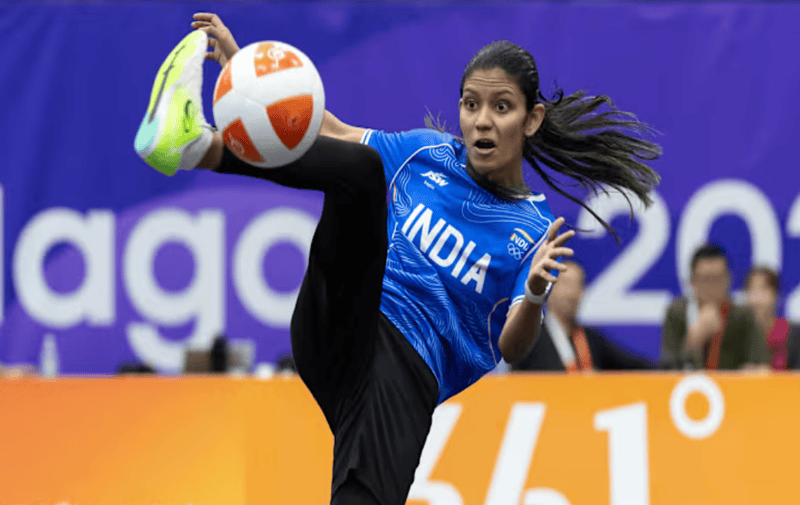
Teqball is played on a curved table with a football, either in singles or doubles. The ball is a standard size-5 football, although it is inflated to a lower pressure. Players can use almost any part of their body except their arms and hands to control the ball.
The challenge? Players get a maximum of three touches before they must send the ball back across the net, and the ball must touch the table to remain in play. Players also cannot use the same body part twice in succession, making quick thinking, balance and incredible ball control essential.
A match follows a best-of-three sets format, with the first player or team to reach 12 points taking a set. And there is one unusual rule: players cannot touch the table. In doubles, there is an additional twist. Teammates must pass the ball to each other at least once before returning it to their opponents.
The result is a sport that looks familiar yet feels completely different once the rallies begin.
Teqball arrived in India in 2019, when Teqball India was formed. However, the game picked up only around 2021–22 after the pandemic slowed its early growth. The country currently has around 180–200 registered players, according to Teqball India technical director Nihar Shah.
India’s three-member Asian Games squad featured Quimcy Dsouza, Mohamed Anas Baig and Declan Gonsalves.
The players are particularly remarkable because they are self-taught and also hold professional jobs. At the Asian Games, Dsouza narrowly missed a women's singles bronze, while Baig and Dsouza also came close in mixed doubles.
India already has an international teqball medal to its name, with Baig and Gonsalves winning men's doubles bronze at the 2024 World Championships in Vietnam. With its Asian Games debut now complete, teqball has gained a much bigger stage in India.
And for a sport born only in 2012, its journey from a Hungarian invention to the Asian Games—and now into India’s sporting landscape—is certainly worth watching.
.jpeg)
I have a Masters in Literature and a knack for spotting the silver lining! When I’m not chasing good news, you’ll find me nurturing my farm or lost in a good book.