"Dream, Dream, Dream! Conduct these dreams into thoughts, and then transform them into action."
- Dr. A. P. J. Abdul Kalam
"Dream, Dream, Dream! Conduct these dreams into thoughts, and then transform them into action."
- Dr. A. P. J. Abdul Kalam
14 Apr 2026
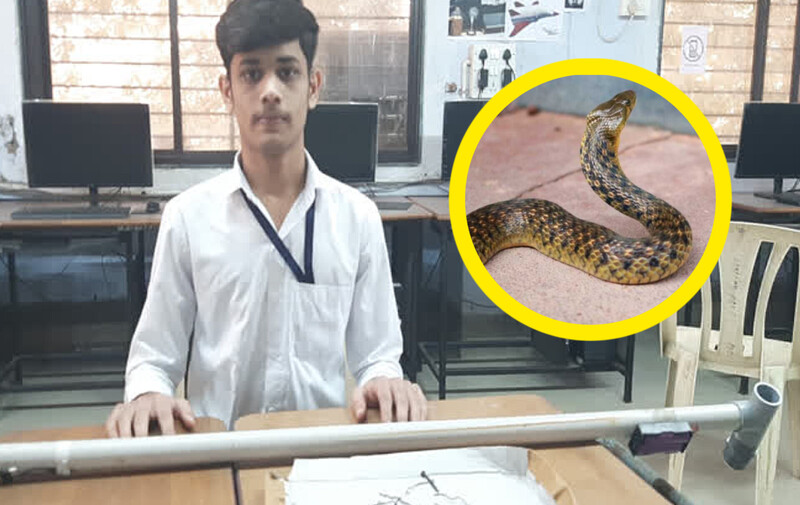
In the heart of Bhavnagar, a quiet yet powerful innovation is taking shape—one that could transform the safety of thousands of farmers across India. At Sir Bhavsinhji Polytechnic College, a group of students has proven that meaningful change does not always require expensive technology. Sometimes, it begins with a simple idea and the determination to solve a real-world problem. Krish Dodiya, a fifth-semester mechanical engineering student, along with his friend, has developed a low-cost “vibrating stick” designed to protect farmers from snake bites and scorpion attacks. Built using basic materials like PVC pipes and a small motor, this device reflects the true spirit of grassroots innovation—practical, affordable, and deeply connected to people’s lives.
For many farmers in India, especially during harvesting seasons, the fields are not just workplaces; they are zones of constant risk. Tall grass, dense crops, and uneven terrain often hide dangerous creatures like snakes and scorpions. Many farmers work barefoot or with minimal protection, increasing their vulnerability. Snake bites alone claim thousands of lives every year in India. The danger becomes even more severe at night, when visibility is low and fatigue sets in. In such conditions, even a single step can turn into a life-threatening moment. It was this reality that inspired Krish and his team. They did not just see a problem; they felt it. Like many students from rural or semi-rural backgrounds, they understood the fear and uncertainty that farmers live with daily.
At first glance, the stick may look like a simple tool. But its functionality lies in a clever understanding of animal behavior. The device is designed to vibrate continuously when it touches the ground. These vibrations travel through the soil, creating a disturbance that snakes and scorpions can sense. These creatures are highly sensitive to ground vibrations. Instead of waiting for a direct encounter, they react early to these signals and move away from the source. In essence, the stick acts as a warning system alerting hidden dangers before they come too close. Krish shared that the team initially struggled to get the vibration right. Their first model produced weak vibrations, which were not effective. After refining the design and increasing the intensity, they achieved the desired result. Remarkably, the entire device costs only around ₹410 to build, making it accessible to even small-scale farmers.
The brilliance of this innovation lies in its simplicity. The stick is made using everyday components: a 3.5-foot PVC pipe, a DC motor, lithium batteries, a spring mechanism, wires, and connectors. These are materials that are easily available and inexpensive. Dr. J.R. Vaghela, a professor from the Mechanical Department, explained that the device is designed not just for effectiveness but also for ease of use. Farmers can carry it effortlessly and operate it without any technical knowledge. This is where the innovation truly stands out. It is not a complex machine requiring training or maintenance. It is a tool designed with empathy, keeping in mind the needs, limitations, and realities of its users.
Krish’s project is part of a larger trend emerging across India, where students are developing low-cost technologies to address rural challenges. These innovations are not driven by profit but by purpose. Some variations of the vibrating stick have already started evolving. Certain models include small pouches containing first-aid supplies or tablets that may help slow venom effects in emergencies. Others have added LED lights for night visibility and buzzers to alert nearby workers in case of danger. This continuous improvement shows that innovation is not a one-time effort. It is a process that grows with feedback, experience, and collaboration.
In a world often driven by complex technology, this story reminds us of the power of simplicity. A PVC pipe, a motor, and a thoughtful idea have come together to create something that could protect lives. Krish Dodiya and his team have shown that engineering is not just about machines—it is about people. It is about understanding problems, feeling them, and finding solutions that truly matter. As India continues to move forward, it is innovations like these that will shape a safer and more inclusive future. Because sometimes, the most powerful changes begin with the simplest tools and the biggest hearts.

Writing about what truly matters, good news and stories to remind the world - it is brighter than we think.