"Dream, Dream, Dream! Conduct these dreams into thoughts, and then transform them into action."
- Dr. A. P. J. Abdul Kalam
"Dream, Dream, Dream! Conduct these dreams into thoughts, and then transform them into action."
- Dr. A. P. J. Abdul Kalam
27 Aug 2026
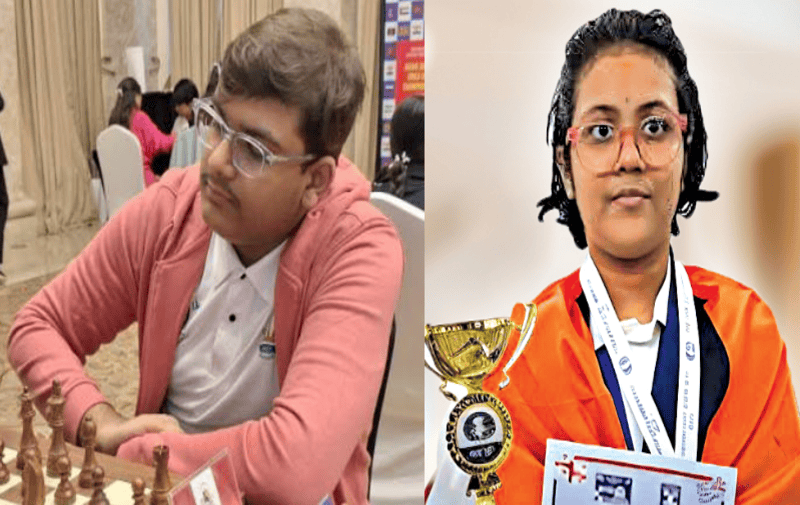
India’s young chess stars delivered a memorable performance on home soil as Mayank Chakraborty and Pratitee Bordoloi emerged champions in the Open and Girls' sections, respectively, at the Asian Junior Classical Chess Championship in Mumbai.
Top seed Mayank lived up to expectations, finishing the nine-round Open Championship with an impressive 7.5 points to claim gold. Russia’s Artem Pingin took silver with seven points, while India’s Daksh Goyal secured bronze with 6.5 points.
In the Girls section, Pratitee matched Mayank’s tally of 7.5 points to complete India’s golden double. Kazakhstan’s Mariya Kholyavko finished second with seven points, while India’s Nivedita V C took bronze with 6.5 points.
India ultimately captured four of the six Classical Championship medals—two gold and two bronze.
The championship proved to be more than a medal-winning outing for the young players. Mayank, already GM-elect, added another Grandmaster norm to his growing list of achievements. Daksh Goyal earned the FIDE Master title along with an International Master norm.
Pratitee’s gold came with an equally significant milestone: she earned the Woman International Master (WIM) title and secured a Woman Grandmaster (WGM) norm. Mariya Kholyavko and Nivedita V C also earned WIM norms.
The triumph became even more special because Mayank and Pratitee share a mentor-student connection.
Mayank, who hails from Assam, has been mentoring Bengaluru-based Pratitee for the past three to four months. Their journey began around the World Youth Chess Championship in Monte Silvano, Italy, where Pratitee won silver and became India’s only medallist at the 2026 edition. This time, however, the colours were gold.
For Pratitee, her mentor’s guidance proved particularly valuable in opening preparation ahead of the tournament.
For Mayank, winning the Classical title carried special significance. While he had previously won the Asian Junior Rapid title, he considers Classical chess the ultimate test—a longer battle demanding extensive opening preparation, mental strength and sustained concentration.
Over six to seven days, every move can carry enormous weight. And in Mumbai, India’s young chess generation showed it has the composure, preparation and talent to thrive under that pressure.
.jpeg)
I have a Masters in Literature and a knack for spotting the silver lining! When I’m not chasing good news, you’ll find me nurturing my farm or lost in a good book.