"Dream, Dream, Dream! Conduct these dreams into thoughts, and then transform them into action."
- Dr. A. P. J. Abdul Kalam
"Dream, Dream, Dream! Conduct these dreams into thoughts, and then transform them into action."
- Dr. A. P. J. Abdul Kalam
3 Mar 2026
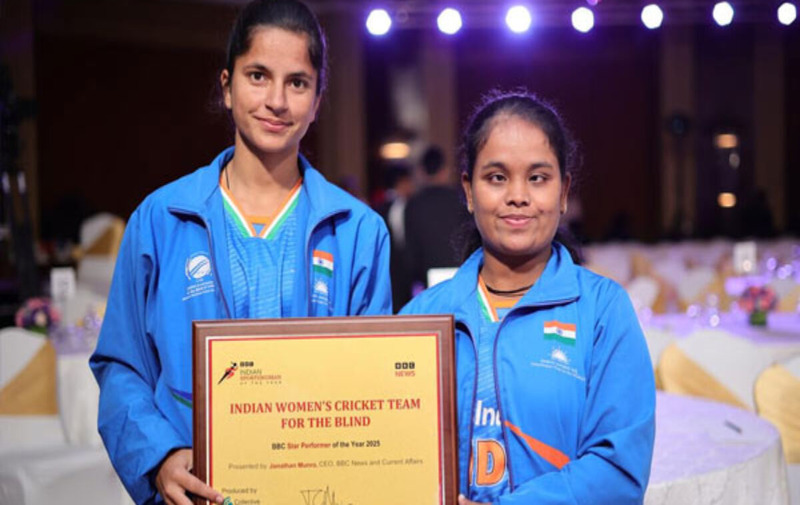
In a world where sport is often measured by speed, power, and precision, India’s Blind Women’s Cricket Team proved that true greatness lies in courage and belief. Their unbeaten triumph at the inaugural Blind Women’s T20 World Cup in November 2025 was not just a victory on the scoreboard; it was a moment that redefined what inclusivity in sport truly means. Soon after lifting the trophy, the team was named among the BBC Star Performers of the Year 2025, placing them in elite global company. It was recognition not only of their cricketing excellence but also of their unbreakable spirit.
The historic tournament, hosted across India and Sri Lanka, marked the first-ever Blind Women’s T20 World Cup. From the very first match, India emerged as a dominant force. Match after match, they displayed tactical sharpness, composure under pressure, and remarkable team coordination. Led by skipper Deepika TC, the side entered the final unbeaten. The summit clash against Nepal at Colombo's P. Sara Oval was expected to be competitive, but India left little room for doubt. Bowling first, the Indian attack restricted Nepal to 114 for 5 in 20 overs. On a surface that offered minimal assistance to bowlers, maintaining disciplined lines and tight fielding required extraordinary communication and awareness — especially in blind cricket, where auditory cues replace visual ones. When it was their turn to bat, India chased down the target with authority, reaching 115 for 3 in just 12.1 overs to seal a seven-wicket victory. The openers built a solid foundation before the middle order calmly guided the team home. It was a clinical performance, reflecting months, if not years, of preparation.
Blind cricket operates with unique rules designed to level the playing field. Players are classified based on their degree of visual impairment, and teams are structured to ensure balance across categories. The ball is larger than a standard cricket ball and contains metal bearings so that players can hear it as it travels. Success in blind cricket depends heavily on sharp listening skills, vocal communication, spatial awareness, and trust between teammates. Field placements, running between the wickets, and bowling accuracy require extraordinary coordination. For the Indian women’s team, mastering these demands while competing on a global stage underscores their exceptional discipline and teamwork.
This World Cup victory was not merely about defeating opponents. It was about challenging perceptions. In a country where access to opportunities for persons with disabilities can still be limited, these athletes demonstrated that ability is not defined by sight. Many players on the team come from modest backgrounds. For them, cricket is more than a sport; it is empowerment, identity, and hope. Families who once worried about their daughters’ futures now celebrate them as national heroes. Their names now sit among the BBC Star Performers of the Year 2025, not as a token gesture, but as champions who earned every accolade. And in doing so, they ensured that the story of Indian cricket in 2025 would forever include a chapter written in courage.

Writing about what truly matters, good news and stories to remind the world - it is brighter than we think.