"Dream, Dream, Dream! Conduct these dreams into thoughts, and then transform them into action."
- Dr. A. P. J. Abdul Kalam
"Dream, Dream, Dream! Conduct these dreams into thoughts, and then transform them into action."
- Dr. A. P. J. Abdul Kalam
18 May 2026
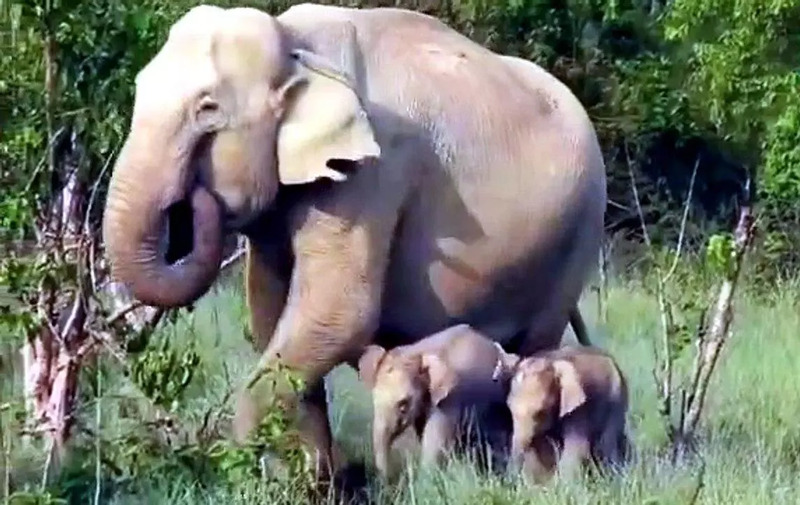
Deep inside the forests of Jim Corbett National Park, nature has delivered a breathtaking surprise. Wildlife experts and forest officials are celebrating after a female elephant was spotted moving through the Garjiya tourism zone with not one but two healthy newborn calves by her side, an exceptionally rare occurrence in the animal kingdom.
The sighting has left conservationists astonished, as elephant twin births are considered one of the rarest natural events among large mammals. Soon after the discovery, forest officials increased monitoring around the area to ensure the safety of the mother and her calves while minimising any human disturbance.
Officials described the successful survival of both calves as a highly encouraging sign for elephant conservation in Uttarakhand’s protected forests.
According to wildlife experts, twin births among elephants account for only around one percent of elephant births globally. The rarity is closely linked to the biology of elephants themselves.
Elephants have the longest pregnancy period among living mammals, carrying calves for nearly 22 to 24 months. Adding to the challenge, elephant calves require years of maternal care, making the successful raising of two newborns physically demanding for the mother.
Scientists explain that large mammals such as elephants have evolved differently from smaller animals when it comes to reproduction. Unlike species that produce multiple offspring at once, elephants prioritise the survival and care of a single calf.
Raman Sukumar, honorary professor at the Indian Institute of Science, Bengaluru, explained that animals with large body size and long lifespans generally give birth to one offspring at a time to maximise survival rates. He pointed out that female elephants are biologically designed to nourish a single calf adequately, which makes twin births especially rare and challenging.
In the wild, raising twins can place immense physical pressure on the mother, particularly because calves remain dependent on her for nourishment and protection for several years.
Wildlife experts believe the successful twin birth reflects the effectiveness of long-term habitat protection efforts in Uttarakhand. Protected forest corridors, reduced habitat disturbance, and stronger conservation measures have helped create safer environments for elephants across the region.
Conservationists say such rare events offer hope and underline the importance of preserving natural ecosystems. Though uncommon, elephant twin births have been documented in a few remarkable cases across India and other countries in recent years.
In 2025, a 57-year-old elephant named Anarkali gave birth to twin female calves in Panna Tiger Reserve, drawing global attention due to the elephant’s advanced age. Another rare case was reported in Bandipur Tiger Reserve in 2022, where forest officials closely monitored twin calves born in the wild.
Still, wildlife experts say the Corbett birth remains extraordinary because both calves appear healthy and active in the wild.
As news of the twin calves spreads, the moment has become more than just a wildlife story, it has emerged as a symbol of hope for conservation in India.
In a world where habitat destruction and human-wildlife conflict continue to threaten biodiversity, the sight of a mother elephant nurturing two newborn calves in the wild is a reminder that nature can still thrive when protected.
.jpeg)
I have a Masters in Literature and a knack for spotting the silver lining! When I’m not chasing good news, you’ll find me nurturing my farm or lost in a good book.