"Dream, Dream, Dream! Conduct these dreams into thoughts, and then transform them into action."
- Dr. A. P. J. Abdul Kalam
"Dream, Dream, Dream! Conduct these dreams into thoughts, and then transform them into action."
- Dr. A. P. J. Abdul Kalam
7 Mar 2026
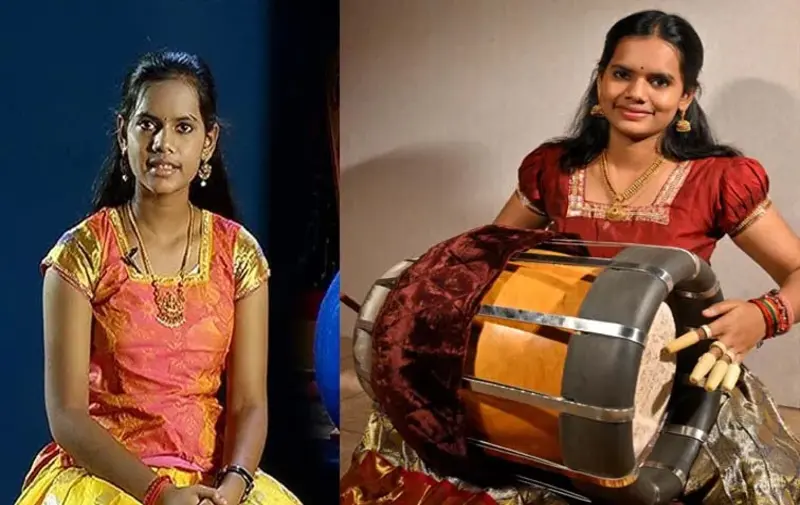
In the vibrant world of Carnatic music, the thavil, a powerful barrel-shaped percussion instrument traditionally played in temple rituals and classical performances, has long been dominated by male musicians. But 18-year-old Amirthavarshini Manishankar is quietly and confidently changing that narrative. From playing in temples near Thanjavur as a schoolgirl to performing at a major concert during the Wonderment Tour led by music maestro A. R. Rahman in Chennai, her journey is not just about music. It is about courage, persistence, and the determination to follow a dream that many believed was impossible for a woman. On this International Women's Day, her story stands as an inspiring reminder that tradition can evolve when someone dares to challenge it.
Amirthavarshini was born into a family where music was not merely a profession but a way of life. She represents the sixth generation of musicians in her family. Her father, A.P. Manishankar, is a respected nagaswaram artiste, while her mother, G. Jayanthi Shankar, is a violinist. Their performances at temple rituals and festivals filled their home with classical sounds from an early age. Naturally, young Amirthavarshini grew up surrounded by rhythm and melody. But while many children in musical families follow predictable paths, she made an unusual choice. At just eight years old, she decided she wanted to learn the thavil, an instrument known for its intensity and physical demands. Her curiosity began with a simple question. “I once asked my parents why there were no women thavil artistes,” she recalls. The answer she received only strengthened her resolve. They explained that the instrument was heavy and physically demanding, requiring stamina, strength, and a posture that made it difficult for many women to pursue professionally. Instead of discouraging her, this explanation motivated her even more.
The thavil is not just another percussion instrument. It is physically challenging and requires immense endurance. Traditionally played alongside the nagaswaram in temple festivals and classical concerts, the instrument produces powerful rhythmic patterns that drive the energy of Carnatic performances. For Amirthavarshini, learning the thavil meant adapting to a demanding routine. The instrument can weigh nearly 60 kilograms, and playing it for long hours requires strong shoulders, legs, and fingers. During practice sessions, her fingers sometimes bleed and may take several days to heal. Before performances, she wraps tape around her fingers and applies glue to secure the caps used to produce the sound. Despite the pain, she never considered giving up. Instead, she embraced the challenge as part of her journey.
Amirthavarshini’s determination was matched by strong guidance from experienced mentors. She became the first female student of thavil guru Adhichaburam A.B. Ramadhass, a significant milestone in itself. Later, she trained under Kovilur K.G. Kalyana Sundharam and continues her advanced training with veteran thavil artiste Thanjavur T.R. Govindharajan. Under their mentorship, she not only learned complex rhythmic patterns but also developed manodharma, the improvisational creativity that lies at the heart of Carnatic music. One of her gurus also encouraged her to play the thavil by resting it on her lap rather than placing it on the floor, a method that requires even greater physical control but offers better tonal precision.
One of the most memorable moments in Amirthavarshini’s young career came when she received an unexpected opportunity from one of India’s most celebrated composers. When A. R. Rahman followed her on Instagram in October, she initially found it hard to believe. Soon after, Rahman’s team contacted her and invited her to perform at his Wonderment Tour concert in Chennai. Standing on stage before a massive audience and performing a solo avarthanam was an emotional milestone.
Amirthavarshini’s first public performance came when she was just 11 years old at the Arulmigu Muthumariamman Temple in Haridwaramangalam. The temple trustee noticed her practicing at home and invited her to perform at the temple’s Panguni festival. She agreed and performed a simple rhythmic sequence, a moment that marked the beginning of her professional journey. Since then, she has shared the stage with several prominent musicians across genres. Her collaborations include performances alongside violinist A. Kanyakumari, flautist Sikkil Mala Chandrasekar, renowned percussionist Sivamani, and singer Daler Mehndi. Her talent has also been recognised nationally. In 2020, she secured third place in the instrumental category of the Kala Utsav competition, organised by the Ministry of Education.
Amirthavarshini is now preparing for another important performance as part of the Women Who Drum ensemble at the Mahindra Percussion Festival in Bengaluru. For her, the thavil is not just an instrument; it represents heritage, responsibility, and cultural continuity. Her message to aspiring women musicians is simple but powerful. At just 18, Amirthavarshini Manishankar has already begun reshaping the landscape of Carnatic percussion. And with every powerful beat of the thavil, she is proving that tradition grows stronger when new voices dare to be heard.
Writing about what truly matters, good news and stories to remind the world - it is brighter than we think.