"Dream, Dream, Dream! Conduct these dreams into thoughts, and then transform them into action."
- Dr. A. P. J. Abdul Kalam
"Dream, Dream, Dream! Conduct these dreams into thoughts, and then transform them into action."
- Dr. A. P. J. Abdul Kalam
6 Oct 2026
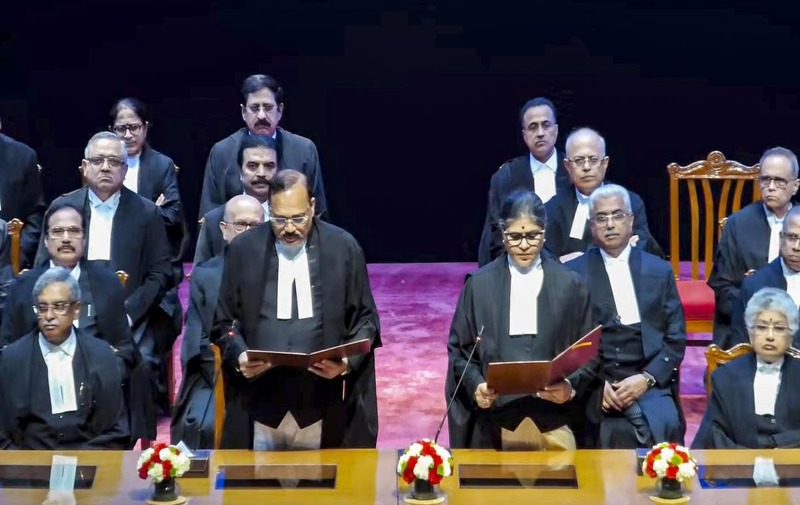
A significant moment for women in India’s judiciary has unfolded at the Supreme Court, where the number of sitting women judges has now risen to three.
With the elevation of Justice Sunita Agarwal, former Chief Justice of the Gujarat High Court, the country’s highest court now has Justice Agarwal alongside Justice BV Nagarathna and Justice Mohana.
While the number is still small, the presence of three women judges at the apex court carries significance in a judicial system where women have remained underrepresented.
Justice Sunita Agarwal brings a long judicial career to the Supreme Court. She began her judicial journey at the Allahabad High Court, was elevated as a High Court judge in 2011 and became a permanent judge in 2013. In July 2023, she was appointed Chief Justice of the Gujarat High Court.
Her elevation also marks the second appointment of a woman judge to the Supreme Court by the Collegium led by Chief Justice of India Surya Kant, following Justice Mohana.
Justice BV Nagarathna, meanwhile, holds a particularly historic place in the judiciary. She is among the women judges who have reached the Supreme Court and is in line to become India’s first woman Chief Justice of India if the seniority convention holds.
The Supreme Court has previously had an even larger representation of women judges.
At one point, between August 2021 and September 2022, four women judges — Justices Indira Banerjee, Hima Kohli, BV Nagarathna and Bela M. Trivedi — served together.
That was the highest number of women judges the Supreme Court had seen at one time. Justice Banerjee retired in September 2022, followed by Justice Hima Kohli in September 2024 and Justice Bela Trivedi in May 2025. For a period after Justice Trivedi’s retirement, Justice Nagarathna was the sole woman on the bench.
The return to three women judges therefore represents an important shift.
The latest appointments take the Supreme Court’s working strength to 37 judges, against a sanctioned strength of 38. But beyond numbers, the growing presence of women at the country’s highest judicial institution carries a larger message.
Every woman who reaches the Supreme Court opens the possibility of inspiring another generation of girls to see the judiciary not as a distant institution, but as a space where they too can lead.
Three women judges may still be far from equal representation. But each appointment adds another powerful voice—and another step forward.
.jpeg)
I have a Masters in Literature and a knack for spotting the silver lining! When I’m not chasing good news, you’ll find me nurturing my farm or lost in a good book.