"Dream, Dream, Dream! Conduct these dreams into thoughts, and then transform them into action."
- Dr. A. P. J. Abdul Kalam
"Dream, Dream, Dream! Conduct these dreams into thoughts, and then transform them into action."
- Dr. A. P. J. Abdul Kalam
13 Jul 2026
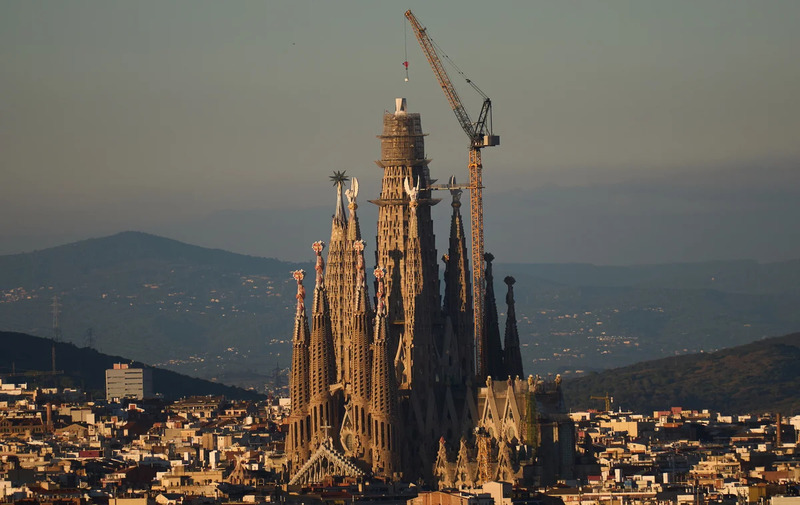
For nearly a century and a half, towering cranes stood alongside Barcelona's breathtaking Sagrada Família, a constant reminder of one of architecture's greatest unfinished dreams. In June 2026, the dream finally became a reality.
After an astonishing 144 years of construction, the iconic basilica has reached its symbolic completion with the installation of a 100-ton cross atop the Tower of Jesus Christ, making it the tallest church in the world at 172.5 metres.
The landmark achievement was celebrated with a grand inauguration attended by Pope Leo XIV and Spain's Prime Minister Pedro Sánchez, coinciding with the 100th anniversary of architect Antoni Gaudí's death. It marked not just the completion of a building, but the fulfilment of one of humanity's most ambitious architectural visions.
According to The Art Newspaper, construction of the Sagrada Família began in 1882 under architect Francisco de Paula del Villar. Less than a year later, a young Antoni Gaudí, just 30 years old, took charge and transformed the modest Gothic Revival design into something the world had never seen. Inspired by nature, Gaudí imagined a basilica that resembled a living forest rather than a conventional church. Towering columns branched like trees, intricate geometries mirrored natural forms, and every detail reflected his deep spiritual beliefs.
Initially believing the project could be completed within a decade, Gaudí soon realised its extraordinary complexity. His famous remark—"My client is in no hurry," referring to God—would become one of architecture's most memorable quotes.
Sadly, Gaudí never saw his masterpiece completed. He died in 1926 after being struck by a tram, with only about a quarter of the basilica finished. He was laid to rest inside the crypt of the very church he devoted the final years of his life to building.
The journey from vision to reality was anything but smooth. Construction came to a halt during the Spanish Civil War (1936–1939), when much of Gaudí's original drawings, models, and designs were destroyed by anarchist groups. Many believed the basilica could never be completed.
Yet architects, engineers, sculptors and craftsmen refused to let the dream die. Working painstakingly from photographs, surviving plaster models, historical records, and their understanding of Gaudí's philosophy, successive generations slowly rebuilt his vision piece by piece.
For the Barbany family of stonemasons, the Sagrada Família became a multi-generational mission. Grandfathers, fathers and sons all contributed to carving columns, sculptures and gargoyles that now define the basilica's magnificent exterior.
While traditional craftsmanship remained at the heart of the project, modern technology accelerated progress. From robotic stone-cutting systems introduced in the early 2000s to sophisticated 3D modelling software, engineers found innovative ways to interpret Gaudí's complex geometric designs while preserving their handcrafted beauty.
The newly completed Tower of Jesus Christ now stands as the basilica's tallest feature, crowned by a radiant four-armed cross made of glass and white ceramic, designed to shine both day and night exactly as Gaudí envisioned.
Its height—172.5 metres—was deliberately kept lower than Barcelona's nearby Montjuïc Hill, reflecting Gaudí's belief that no human creation should surpass God's creation.
For residents of Barcelona, witnessing the completion has been an emotional experience. Many compare it to watching the Eiffel Tower rise over Paris or seeing the Taj Mahal completed centuries ago. After generations of living alongside cranes and construction barriers, the city's skyline has finally revealed the masterpiece in its intended form.
Although decorative work, including the monumental Glory Façade, will continue over the coming years, the symbolic completion marks the end of one of the world's longest-running construction projects. Today, the Sagrada Família stands as far more than a church. It is a monument to patience, resilience, artistic genius, and unwavering human determination.
Gaudí may not have lived to see his masterpiece completed, but 144 years later, his extraordinary vision finally reaches the heavens. Some dreams are simply worth waiting for.
.jpeg)
I have a Masters in Literature and a knack for spotting the silver lining! When I’m not chasing good news, you’ll find me nurturing my farm or lost in a good book.